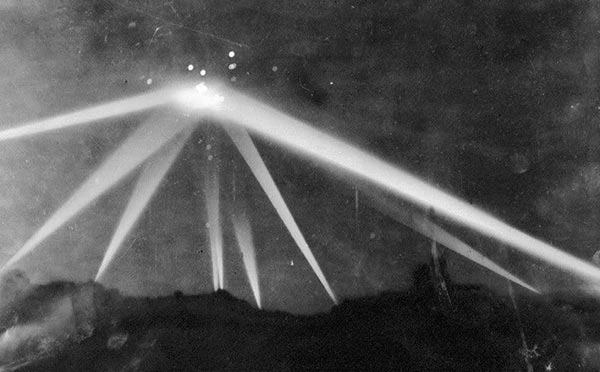
Image: Searchlights during the Los Angeles air-raid alarm of February 1942. The photograph does not establish the presence of a solid craft. Credit: Unknown photographer / Associated Press, via Wikimedia Commons. Public domain in United States: published 1931–1963 without copyright renewal, per Commons rights statement. Other jurisdictions may differ. Image source.

In the early hours of 25 February 1942, antiaircraft guns opened fire above Los Angeles. The shooting was real. Whether the defenders had identified an aircraft was another question. That distinction is central to understanding an episode later absorbed into UFO history.
An alarm in a vulnerable city
The official Army Air Forces history places the incident after a Japanese submarine shelled installations at Ellwood on 23 February. It describes a radar warning, a regional blackout at 2:21 a.m., and increasingly inconsistent reports. A balloon carrying a red flare was reported over Santa Monica at 3:06 a.m. The history records 1,440 rounds fired, no enemy losses, and no bombs dropped. Navy Secretary Frank Knox called the episode a false alarm; the Army initially entertained aircraft explanations. These are findings and reported observations in a retrospective government history, not a surviving instrument record demonstrating an extraordinary vehicle. Read the official history, pages 282–286, reproduced by HyperWar.
What the later assessment proposed
The same account suggests meteorological balloons may have started the alarm and describes shell bursts and drifting smoke complicating observation. That wording matters: it proposes a reconstruction rather than supplying a positively identified object for every report. Its footnotes point back to wartime command histories, messages and contemporary newspapers. The accessible edition therefore lets readers distinguish the historians’ explanation from the reports they evaluated.
There is a common logical trap here. If soldiers fired at a reported target, that establishes a military response. It does not establish that every estimate of the target’s shape, distance or speed was accurate. Nor does the absence of a downed aircraft demonstrate that an object possessed an impenetrable surface. A claim of invulnerability requires evidence that a physical target was present and struck, not simply that ammunition was expended.
Reading the photograph cautiously
The familiar searchlight photograph is an important artifact of the event. It records an illuminated night sky and the public spectacle of the barrage. It cannot, on its own, identify the material at the intersection of the beams. A bright patch in a photograph must not automatically become a solid craft in the caption. The archived image and its provenance should travel with any reproduction.
The most useful unresolved questions are narrow: what initiated particular alerts, which observations were independent, and how much later reporting repeated earlier impressions. Those questions invite comparison of dated records. They do not require choosing between a flawless military explanation and an extraterrestrial visitation.
Los Angeles belongs in the history of unidentified aerial reports because it shows how uncertainty can become an operational emergency. The surviving account supports a serious failure of identification under wartime pressure. It does not provide verified evidence of a nonhuman aircraft. Keeping those conclusions separate preserves both the event’s historical importance and the limits of its evidence.
Leave a Reply