The Datil, New Mexico, UFO file illustrates a complication in historical case labels: an explanation can arrive long after the observation, using evidence unavailable to the original investigators.
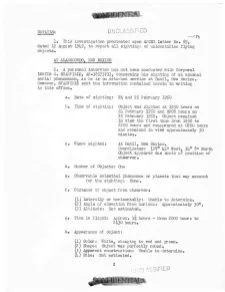
Corporal Lertis E. Stanfield of the 3024th Air Police Squadron at Holloman reported a photographed object on February 24–25, 1950. The National Archives reproduces a three-page investigation dated March 7. Project Grudge did not establish an explanation at the time.
A later comparison changed the classification
According to the Archives’ 2018 review of the file, a similar-looking Soviet photograph and photographs of known comets later supplied a different interpretive context. Project Blue Book ultimately treated the Datil object as a comet, roughly a decade and a half after the original report.
The distinction matters: similarity between images is an argument for an identification, not a newly obtained measurement of the photographed object’s distance or trajectory. The later assessment should not be rewritten as something the first investigation had already demonstrated.
How to read the changing record
There are two questions here. What could investigators establish in 1950? And how persuasive was the later comparison? The first can remain limited even when a subsequent reviewer favors a natural explanation. Conversely, the initial lack of an explanation is not evidence that an extraordinary craft was present.
Readers should examine the reproduced reports rather than treating either the original uncertainty or the later label as the entire story. This is a review of an archival case, not a new observation or new government release.
Source: National Archives review, including the March 7, 1950 investigation scans.
Featured image: First page of the U.S. Air Force investigation, March 7, 1950. National Archives, Identifier 595175. Public-domain government record.
Leave a Reply