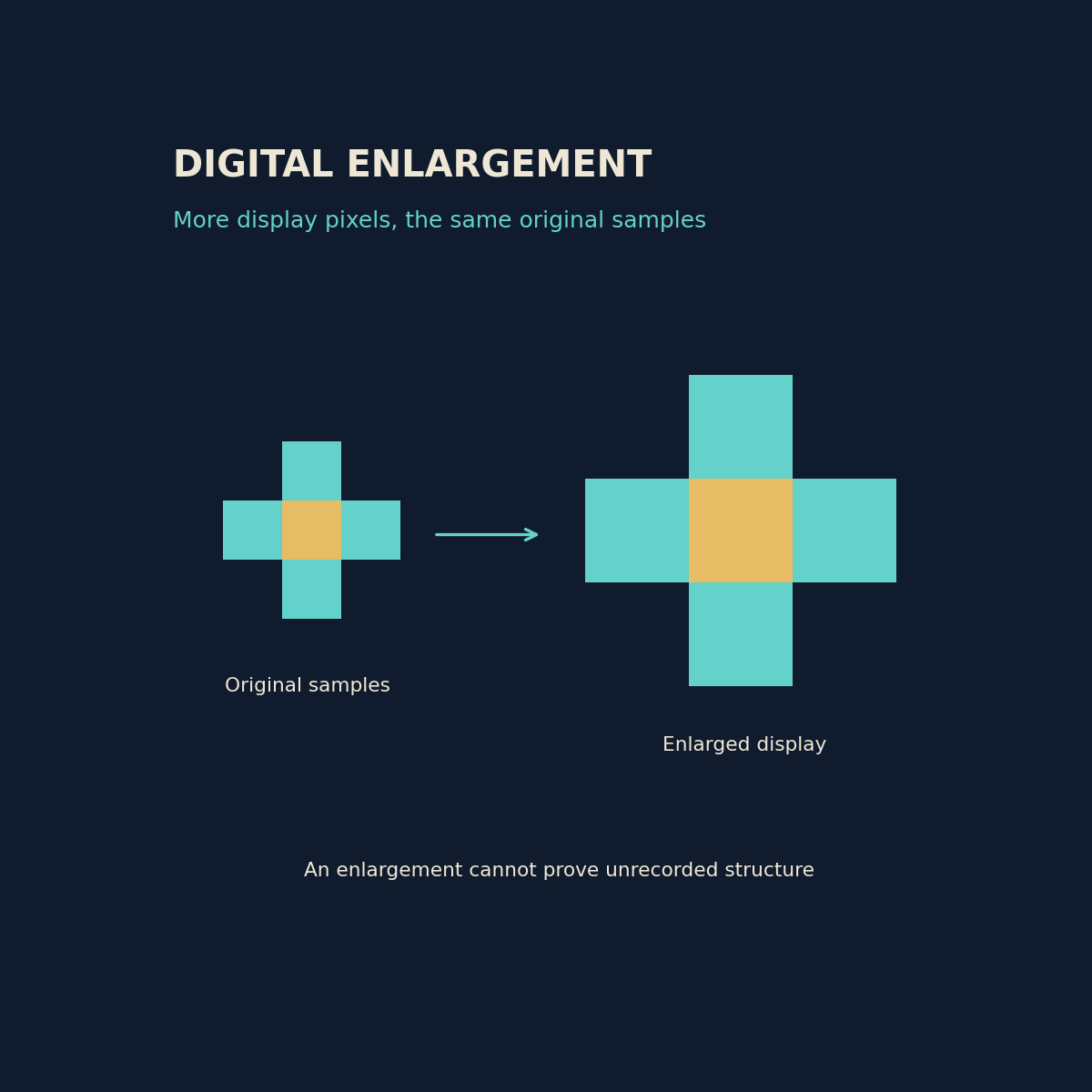
Original diagram by Dark Fires. Schematic, not an observation; not to scale.
A light can fill a phone screen while still being represented by very little independent scene information. Zoom labels describe an imaging operation, not a guarantee that an object’s surface or outline has been resolved. For UAP analysis, the useful question is what detail reached the sensor before enlargement and processing.
Separate optical capture from enlargement
Optical zoom changes the image formed by the lens. Standard digital zoom enlarges information already captured. Sony’s documentation distinguishes conventional digital enlargement from other branded zoom modes and explains that ordinary digital zoom estimates additional image signals. Those estimates can make a picture easier to inspect without providing the same evidence as additional optical sampling.
The exact pipeline matters. A phone may switch lenses, crop a higher-resolution sensor, combine frames or apply computational enhancement as a zoom slider moves. Do not assume every enlargement behaves identically. Record the device, camera application, selected lens, capture mode and original image dimensions. A simple on-screen “10×” label is insufficient to reconstruct that history.
A hypothetical pixel example
Imagine a distant source covering only three original pixels across. Enlarging the picture fourfold can display that source across twelve output pixels. The larger display makes the original sample pattern easier to see, but the extra output pixels are not twelve separate measurements across the source. A smooth border may be interpolation, and a crisp-looking rim may depend on processing.
This does not mean enlargement is useless. It can help locate a source, compare frames or show a feature already present in the original. The evidential problem starts when a processed enlargement is treated as proof of windows, panels, appendages or a precise silhouette that cannot be demonstrated in the underlying samples.
A reproducible inspection method
Begin with the untouched original at native resolution. Make separate, clearly labeled copies for enlargement. Compare a nearest-neighbour display, which exposes the pixel grid, with a conventional smooth enlargement. Neither becomes a ground-truth photograph; the comparison simply reveals how strongly the apparent shape depends on the display method.
Keep a record of crop boundaries, scaling factor and enhancement settings. If software reconstructs or generates plausible detail, label the result as an interpretation and exclude it from measurements of unobserved structure. Do not place a reconstructed illustration beside the original without a prominent explanation of the difference.
For a continuing observation, prioritize a stable original recording and optical capture where available. Sony’s zoom guidance recommends optical-only settings when prioritizing image quality. This is practical camera advice, not a promise that optical zoom will resolve every distant light.
A defensible conclusion
Report the source’s original pixel extent, the enlargement method and which features persist without enhancement. If the object remains unresolved, say so. A large image can be useful evidence of a light’s presence while remaining weak evidence of its physical construction.
Leave a Reply