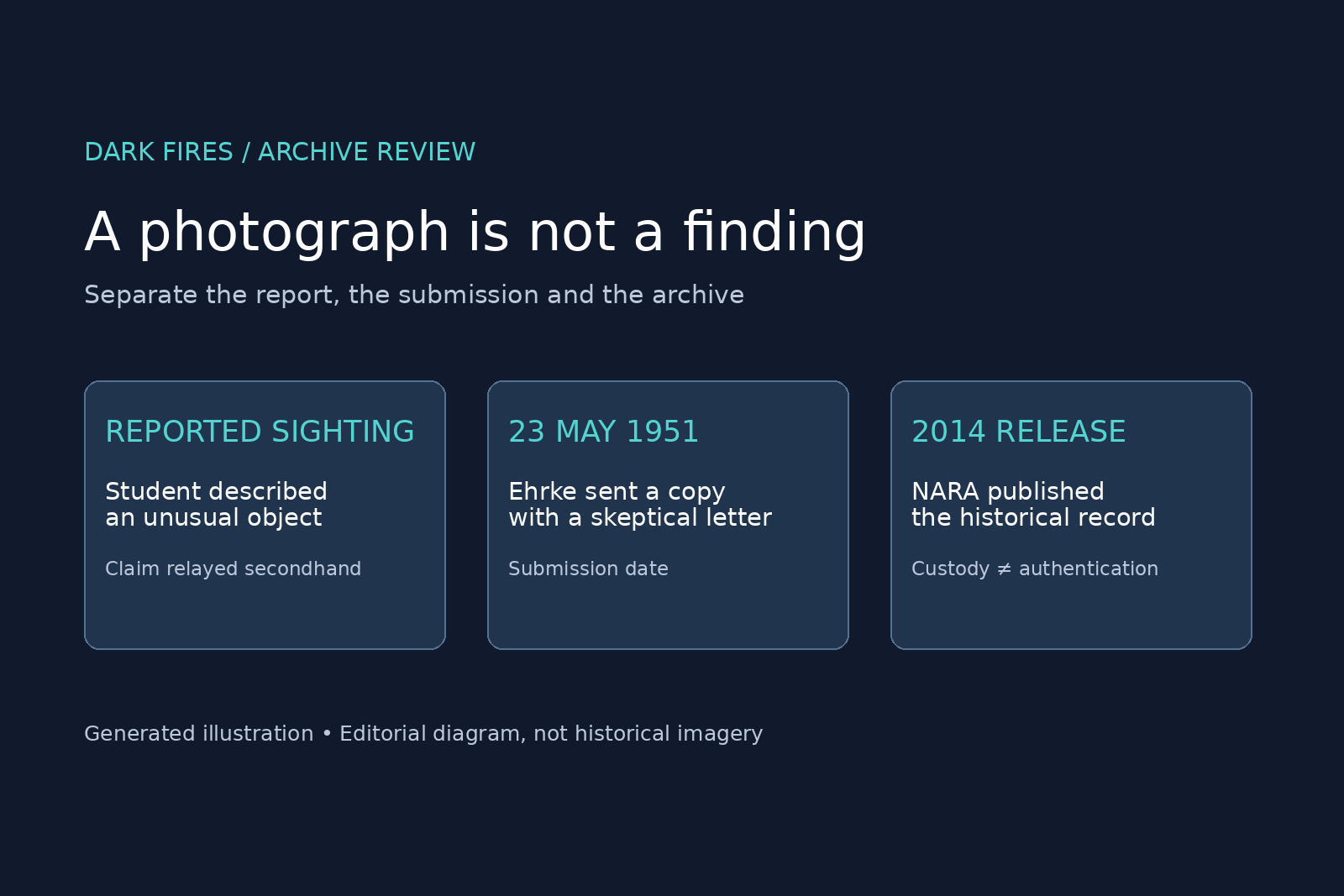
A photograph in an Air Force flying-disc file can look more authoritative once it appears on a government website. Albert Ehrke’s 1951 submission is a useful antidote to that shortcut: the accompanying letter is skeptical, secondhand and more informative about provenance than about the object’s identity.
This is a review of an existing historical record. The letter is dated 23 May 1951. The National Archives published its discussion on 28 March 2014; neither date should be mistaken for a precisely established sighting date.
Read the letter before the picture
In the scanned letter, Ehrke says he met a young man while attending Fullerton Junior College during 1949–50. That man reportedly watched an unusual flying object northwest of Fullerton and obtained two pictures. Ehrke says he acquired copies and sent one to the Air Force.
That is a chain of reporting, not a direct eyewitness account by the correspondent. The letter attributes the sighting and photography to someone else. It does not supply the original photographer’s name, an exact observation time, an exposure record or a measured distance to the subject.
Ehrke says the submitted picture was taken with infrared film and the other with ordinary film. He also repeatedly calls the pictures fake and suggests a research balloon. Those are his descriptions and suspicions, not a laboratory result proving either fabrication or a balloon identification.
What the archive establishes
The National Archives’ 2014 article places the material in Air Force intelligence correspondence, Record Group 341, box 293, in a folder covering flying discs in 1951. It provides both the letter and the associated image scan. The archival citation gives a reproducible route to the record. It does not certify the photographic subject as a craft or validate the correspondent’s proposed explanation.
The letter also carries an office notation that a reply was unnecessary. That is evidence about administrative handling, not a technical analysis. The published material reviewed here does not include a demonstrated reconstruction of how the image was made.
Two errors to avoid
It would be wrong to present this as an Air Force-confirmed extraordinary object. It would also be wrong to claim that the sarcastic tone alone proves a hoax. A writer’s confidence and the evidential strength of a photograph are separate questions.
A useful follow-up would seek the original negatives, the photographer’s account, camera and film details, and any contemporary analysis. Without those, the responsible conclusion stays limited: an authentic archival submission can preserve an unverified claim. Government custody establishes where the document survived, not what was in the sky.
Featured image: original Dark Fires editorial diagram, AI-authored; Generated illustration. No simulated sighting or fabricated historical document is shown.
Leave a Reply