A new Simons Array analysis expands a difficult search in the oldest observable light: circular polarization in the cosmic microwave background. The result is not a detection. It is a set of upper limits, together with an instrument-and-analysis method that could make future searches more capable.
The POLARBEAR Collaboration preprint, submitted November 9, 2026, reports observations at 90 gigahertz with the POLARBEAR-2b receiver in Chile’s Atacama Desert. It has been submitted to the Astrophysical Journal; the preprint should not be confused with a completed peer-reviewed publication.
A different kind of polarization
Most cosmic-microwave-background polarization work measures linear polarization, commonly described through E and B patterns. Circular polarization instead describes radiation whose electric field rotates as the wave travels. In this context the sought-after sky pattern is called a V mode.
The standard cosmological picture does not predict an appreciable primordial circular-polarization signal. But several processes could generate a small one, including conversion of existing polarization as radiation passes through magnetized plasma. More speculative mechanisms also exist. A search therefore has scientific value without requiring a claim that new physics has appeared.
What this measurement adds
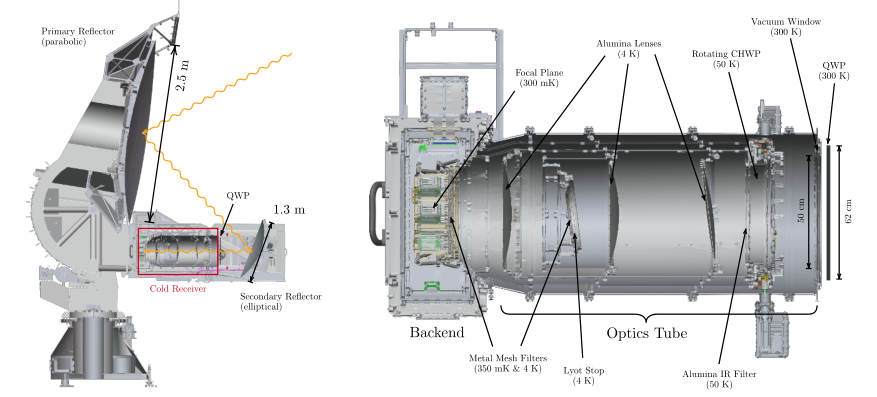
The team combines a stationary quarter-wave plate with a rotating half-wave plate, allowing the receiver to recover information about circular polarization. Its analysis covers angular scales of roughly 5.4 to 36 arcminutes, corresponding to multipoles 300 through 2000. The authors describe this as roughly tripling the highest multipole previously reached in a V-mode power-spectrum measurement: smaller angular structures are now being tested.
The observations amount to about two and a half months on each of two fields away from the Galactic plane, with an effective combined area near 12 square degrees. The published 95% upper bounds on the scaled polarization power range from about 22 square microkelvin at the largest analyzed scales to about 3,500 square microkelvin near the smallest. These are limits on a statistical power spectrum, not temperatures of individual celestial objects.
Why a non-detection still needs caveats
The analysis accounts for known foreground contamination rather than simply treating everything measured as cosmological. The paper also reports substantial instrument limitations: the receiver’s on-sky sensitivity fell short of its original target, and the added quarter-wave plate reduces transmission. The resulting limits are consequently constrained by the actual apparatus, not just by how much sky was observed.
This distinction keeps the conclusion proportional to the evidence. The result does not establish that circular polarization is absent everywhere, nor does it discriminate among all proposed generation mechanisms. It tests a specified frequency and range of angular scales at a stated sensitivity.
The practical advance is a reproducible route for extending the search. More sensitive observations and independent implementations can turn a currently weakly measured property of the microwave sky into a more useful probe. For now, the new boundary on what remains unseen is the finding.
Featured diagram: POLARBEAR-2b optical layout, Figure 1 from the POLARBEAR Collaboration paper, CC BY 4.0. Instrument schematic, not an image of a detected sky signal.
Leave a Reply