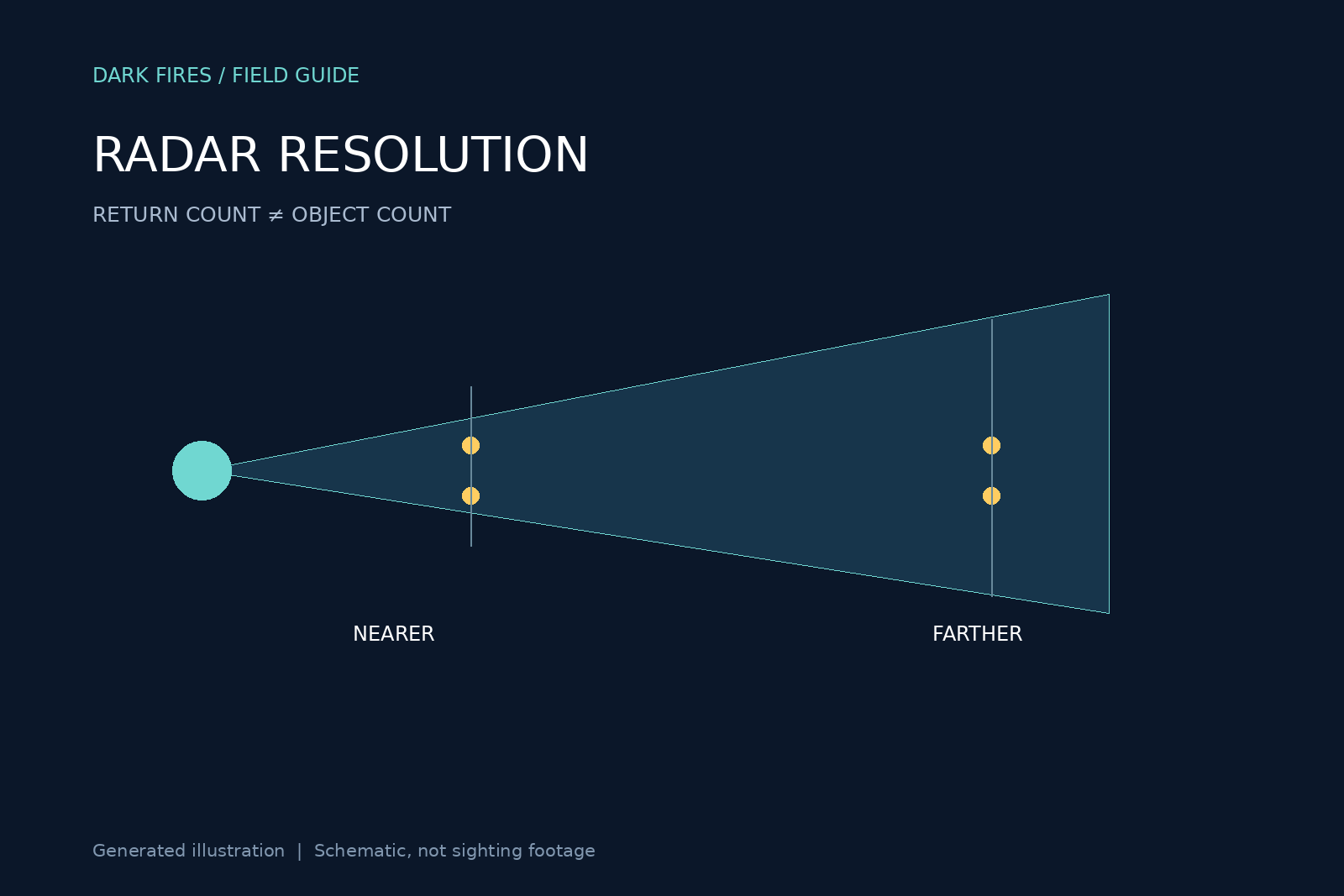
A radar plot is not a photograph of a collection of objects. When a UAP account says one return became several, an important preliminary question is whether the instrument could resolve the returns separately at both moments. Changes in the displayed count need not mean that a physical object split apart.
A beam covers a volume
NOAA’s explanation of radar beams describes a beam whose intensity fades outward rather than ending at a hard edge. It also widens with distance. NOAA illustrates the consequence with weather radar: small-scale features can merge or disappear from view when they lie farther from the instrument.
The page gives a beam width of roughly one degree for WSR-88D weather radar and compares views of the same storm from different distances. Those are specifications and examples for that radar system, not measurements of a military sensor in a UAP case. Transferring them to an unidentified instrument would introduce false precision.
Separation has more than one dimension
Radar needs enough discrimination in direction and range to distinguish nearby reflectors. The National Weather Service’s basic radar principles training discusses pulse characteristics, pulse volume and target resolution. Two echoes may overlap in one dimension even if they differ in another. The displayed picture also depends on what processing preserves or combines.
For a reader assessing a UAP claim, the key distinction is between objects, echoes, detections and tracks. An echo is received energy; a detection is a decision that a signal meets a criterion; a track associates detections across time. These terms should not be used as interchangeable counts of physical vehicles.
What an informative release would contain
Our suggested evidence request starts with the radar type and operating mode, observation ranges, beam or angular resolution, range resolution, scan times and display-processing details. Ask whether the “split” is visible in underlying detections or only in a processed animation. Preserve original timestamps and track identifiers, including any gaps.
A useful test compares the claimed separation with the instrument’s resolving capability at that range. Another checks whether the display scale, threshold or tracking state changed near the apparent event. These are questions for the record, not assumptions about what a particular operator did.
Resolution limits do not prove that a report is mistaken, and they do not explain every change in a track. If a suitably documented system resolves independent returns well beyond its uncertainties, that is stronger evidence than an ambiguous display alone. Even then, the returns’ physical identity remains a separate question. A count becomes meaningful only when the measurement process behind it is known.
Featured image: original Dark Fires schematic. Generated illustration; not an observation or sighting photograph.
Leave a Reply