A rare version of a familiar molecule has appeared in the material around a young star. Astronomers using ALMA have detected fully deuterated methanol in interstellar space for the first time, adding a demanding new test for theories of how organic chemistry develops before planets form.
The Max Planck Institute for Radio Astronomy announced the result on October 7, 2026. The molecule was identified around IRAS 4A2, a protostar in the Perseus molecular cloud roughly 1,000 light-years away. Arnaud Belloche led the study.
A molecular record of the cold
Ordinary methanol contains four hydrogen atoms. In the newly detected version, written CD3OD, all four are replaced by deuterium, a heavier isotope of hydrogen. These substitutions are useful because cold interstellar chemistry can produce distinctive patterns of deuterium enrichment.
Methanol is also involved in making larger organic molecules. Laboratory work suggests that much of this chemistry takes place on icy dust grains before a star fully develops. Warming then releases molecules into surrounding gas, where telescopes can identify their characteristic spectral lines. The relative amounts of different methanol variants help researchers trace that earlier history.
According to the institute, fully deuterated methanol is about a hundred times more abundant than available chemical models predict. That mismatch points to missing or inadequately represented chemistry in the models.
A stronger test, with uncertainties attached
The research paper, posted on October 5 and accepted by Astronomy & Astrophysics, also identifies a measurement complication. Estimates of ordinary methanol’s abundance may be too low. The authors suggest that emission from clumps, rather than one uniform region, could help explain some unusual isotope ratios. The molecular identification and the detailed interpretation of its abundance are separate parts of the result.
The observations belong to COMPASS, an ALMA survey of 11 young, Sun-like stellar systems. NRAO’s overview describes more than 100 hours of telescope time and an initial set of seven papers. Comparing different birth environments and evolutionary stages should help distinguish chemistry inherited from cold clouds from changes made as stars grow.
For astrobiology, the interest lies in the chemical material that emerging planets may receive. Methanol can form without biology, so this detection makes no claim of life around IRAS 4A2. It instead gives researchers a more detailed starting point for understanding which organic ingredients can exist long before a habitable world is possible.
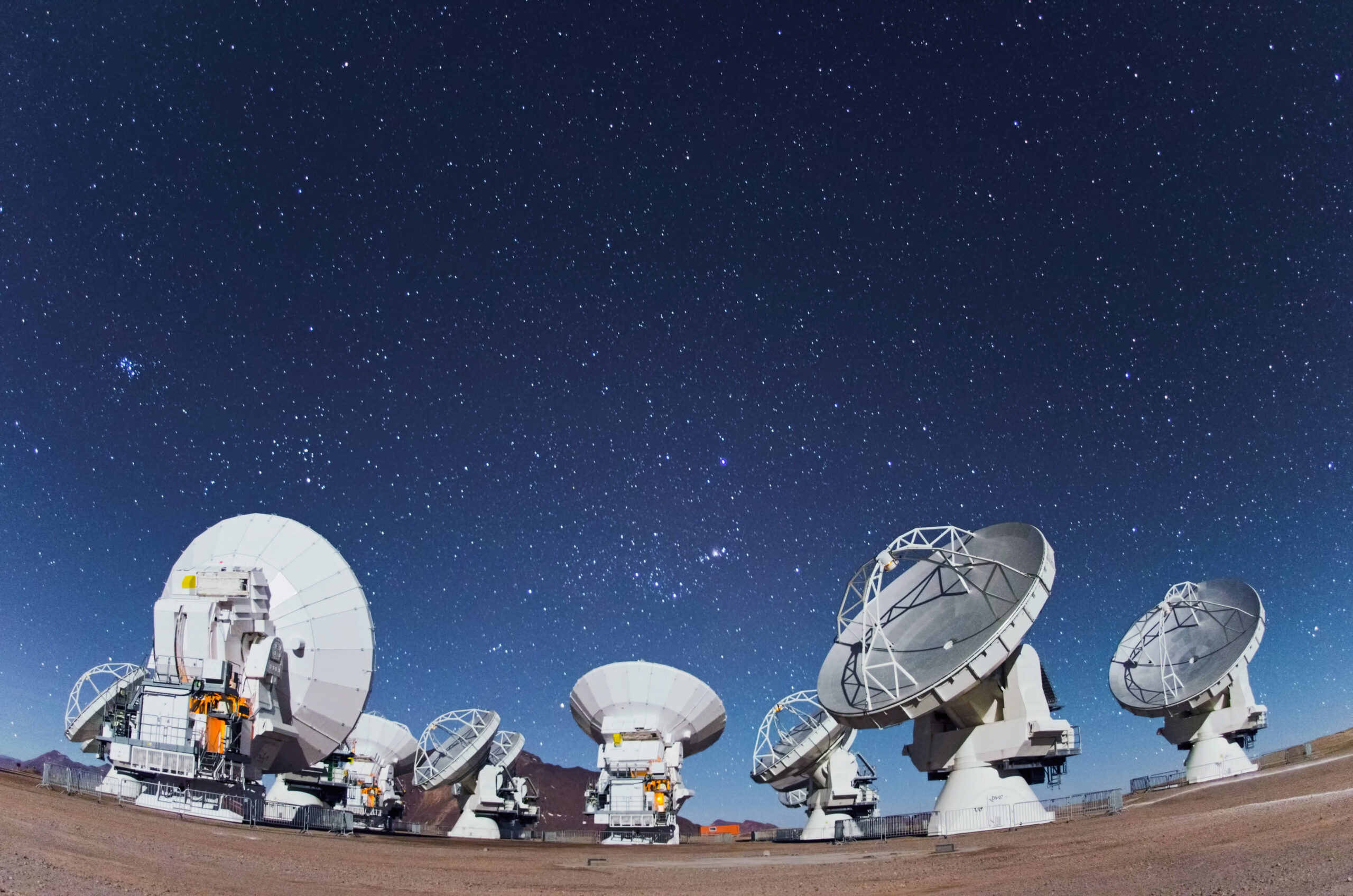
Featured image: ALMA antennas on Chile’s Chajnantor plateau in an archival image released in June 2013. Image: ESO, CC BY 4.0. Image displayed at reduced size; homepage thumbnails may be cropped.
Leave a Reply