A salt-loving Earth microorganism has grown during a 160-day experiment combining several stresses relevant to possible shallow habitats on Mars. The result strengthens a laboratory method for studying habitability while leaving a central planetary question open: whether a suitable environment actually exists there.
The study, published November 5, 2026, in Applied and Environmental Microbiology, tested Haloferax volcanii, an archaeon. Researchers maintained cultures in salty liquid under oxygen-free, carbon-dioxide-rich conditions at 24 millibars, far below ordinary terrestrial atmospheric pressure. Cultures received nitrate or perchlorate as alternative electron acceptors for metabolism.
Separating survival from growth
Being recoverable after exposure to a hostile setting is different from multiplying within it. The researchers used changes in optical density, together with chemical measurements of nitrate and perchlorate reduction, to assess activity. Cultures without the added compounds showed no significant increase in optical density, providing a comparison against the growing treatments.
Growth at low pressure was lower than in comparable Earth-pressure cultures. Electron microscopy also revealed biofilms in the growing low-pressure treatments, while the liquid lost less than four percent of its volume over the experiment. These observations give future studies several measurable outcomes beyond a simple alive-or-dead result.
The limits of the simulated habitat
The University of Florida’s account of the work emphasizes two important advantages the organisms received: a temperature of about 21 degrees Celsius and nutrients provided by the researchers. Much of the Martian subsurface is considerably colder. The proposed liquid-water pockets motivating the experiment have not been confirmed on Mars.
Those qualifications define what the result can support. It demonstrates that this terrestrial organism can grow under a particular combination of laboratory conditions. It cannot establish that those conditions occur together naturally, persist long enough, or contain the necessary food on another planet.
The experiment also has a practical connection to spacecraft cleanliness. Knowing which microbes can remain active under combinations of planetary stresses helps researchers assess contamination risks, as well as design instruments to look for biological activity.
For life-detection research, the useful next question is which constraints change the outcome. Temperature, nutrient availability and the stability of liquid water each need to be tested alongside the stresses already combined here. A laboratory success becomes more informative when its boundaries are mapped as carefully as its favorable result.
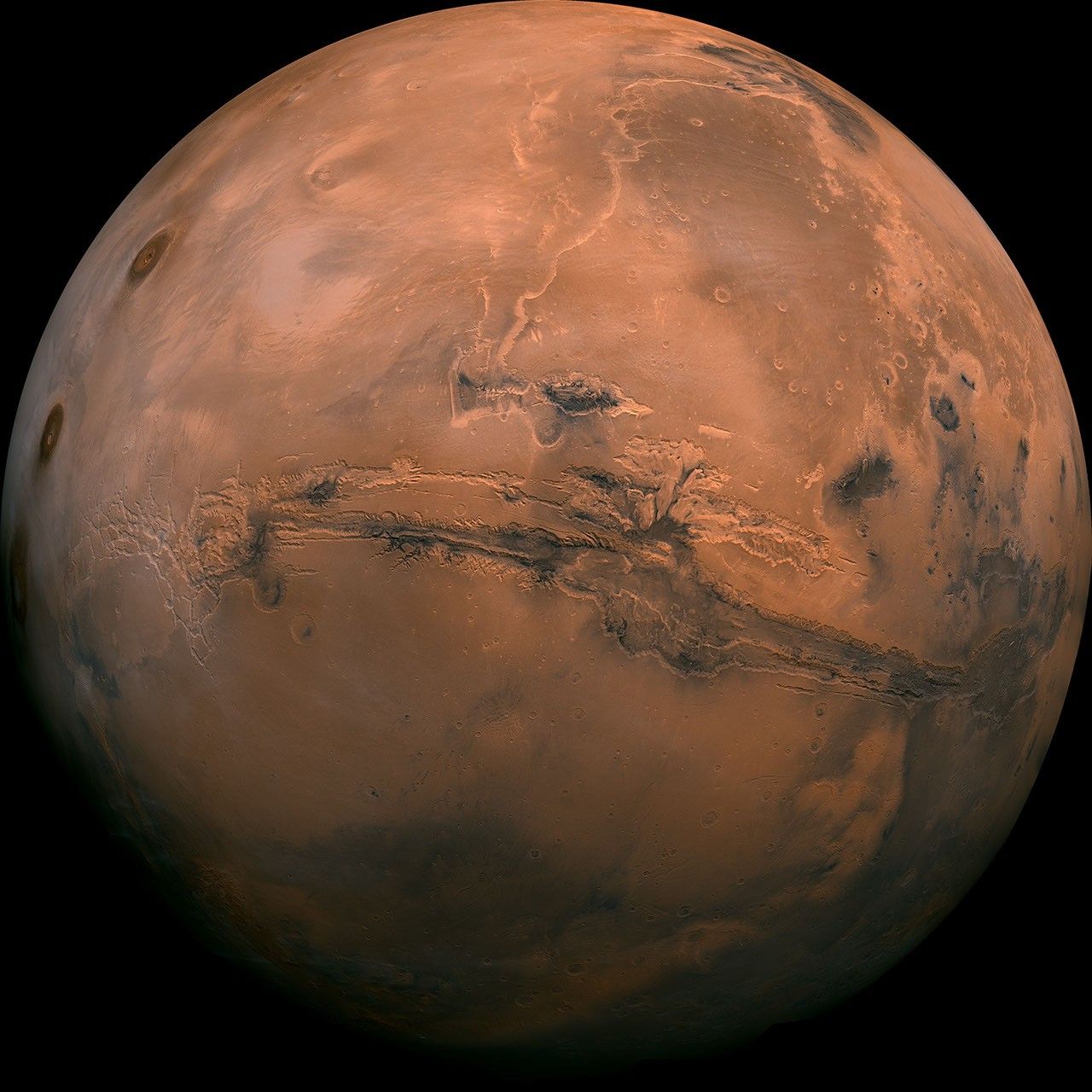
Featured image: NASA/JPL-Caltech. Mosaic made from 102 Viking Orbiter images. Public-domain NASA imagery; contextual image, not the laboratory experiment or a confirmed habitat. Image source.
Leave a Reply