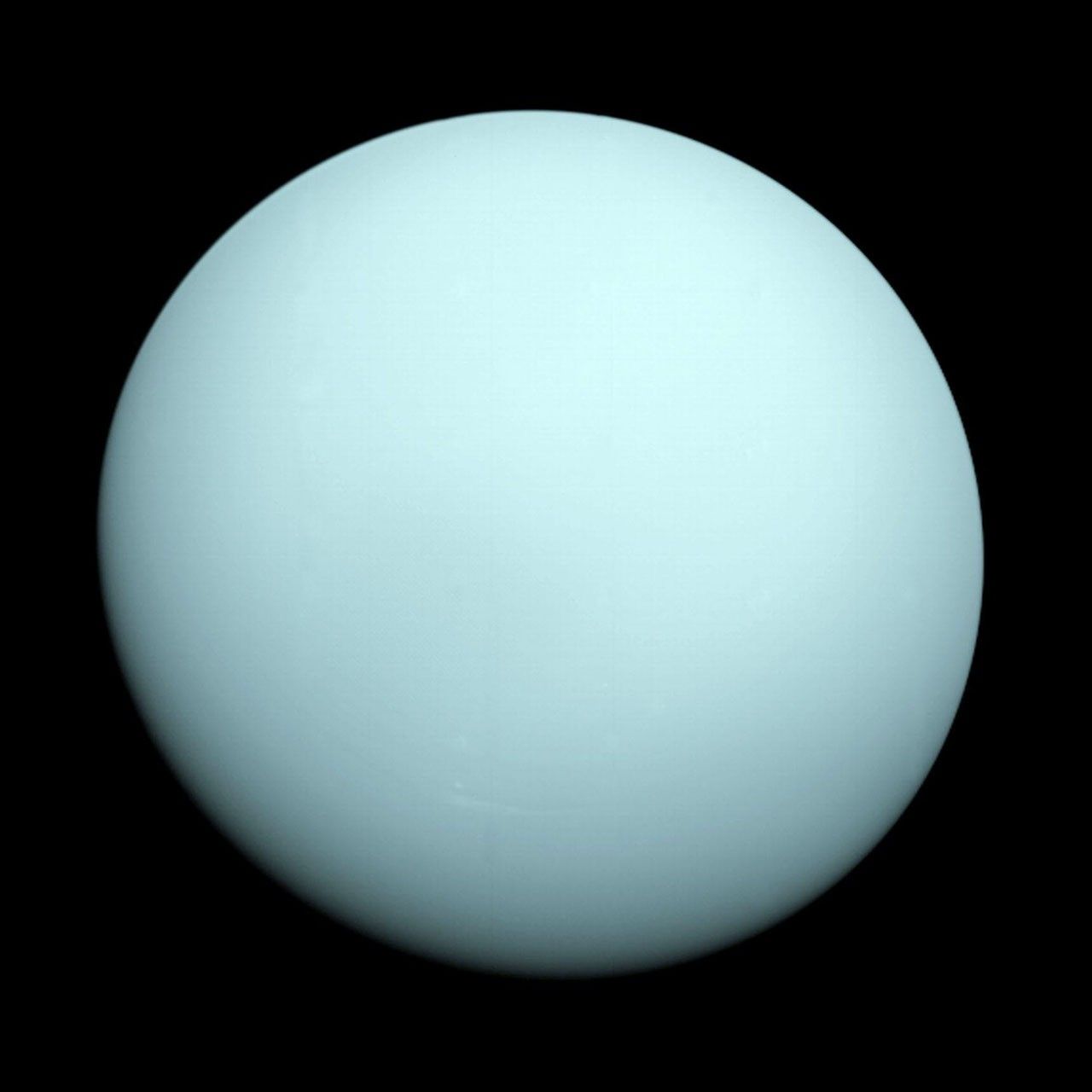
The magnetic maps of Uranus and Neptune rest on a remarkably small foundation: one spacecraft flyby of each planet. New computer models suggest those maps may also describe fields that change substantially over decades, making their age an important part of how astronomers interpret observations today.
A study published November 3, 2026, in Communications Physics identifies changing electrical conductivity with depth as a route to producing the ice giants’ unusual magnetic geometry. It does not measure a newly shifted magnetic pole. Instead, it tests a physical mechanism capable of generating fields resembling those Voyager 2 encountered.
Conductivity changes the dynamo
Planetary magnetic fields arise from moving, electrically conducting material inside a planet. In the simulations, making conductivity increase toward greater depth helped produce complex fields rather than a dominant magnetic alignment with the rotation axis. The result appeared across different thicknesses of the modeled convecting shell.
The University of Texas at Austin’s November 3 announcement explains why such a gradient is plausible. Under intense pressure and heat, water-rich material can become increasingly conductive as molecules break into ions. The actual composition and structure of both planetary interiors remain uncertain.
The contrast with Earth is striking. The university’s summary gives magnetic dipole tilts of about 59 degrees for Uranus and 47 degrees for Neptune, compared with roughly 11 degrees for Earth. Those angles are one description of the difference; the ice giants also have complicated magnetic structures that cannot be captured by a simple tilted bar magnet.
A prediction that needs a time series
Some simulated intervals show large changes over decades, while others evolve slowly. The paper therefore treats temporal variation as plausible, with its real extent poorly constrained. A model that reproduces one observed configuration cannot by itself establish how the actual planet traveled to that configuration or where its field points now.
Researchers are examining infrared auroral observations from Webb for clues. Auroral patterns can help test magnetic geometry, but interpreting them also requires understanding how particles and atmospheric conditions produce the emission. New spacecraft measurements would provide a more direct comparison with Voyager.
The practical lesson is about time as well as distance. A remote planet’s old measurement remains valuable, but assuming that it is a permanent map can build hidden uncertainty into newer results. These simulations make that assumption testable.
Featured image: NASA/JPL. Voyager 2 photograph of Uranus, January 14, 1986. Public-domain NASA imagery. Image source.
Leave a Reply