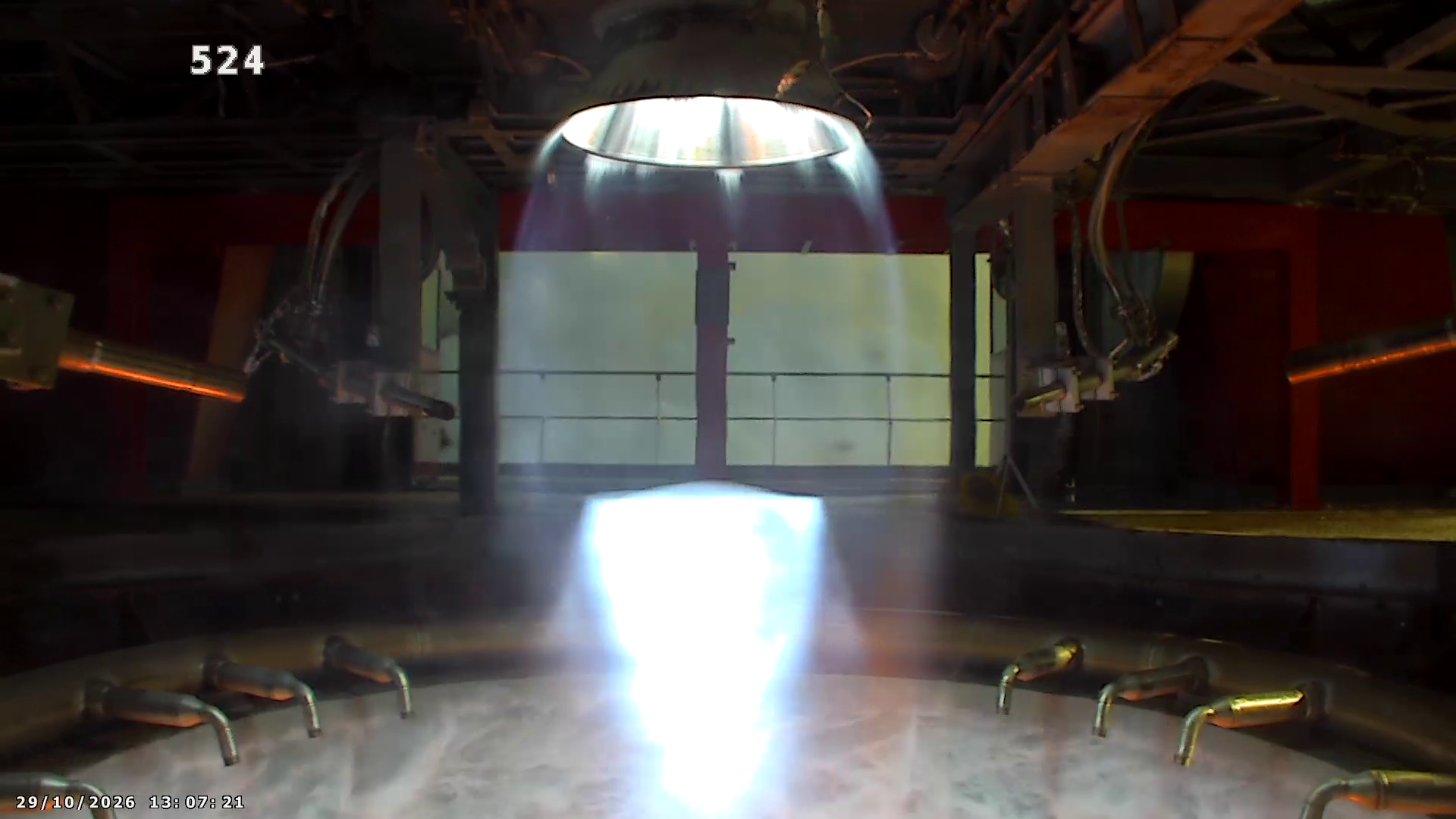
Prometheus fires at the upgraded P5 test bench during the campaign reported by ESA on 6 November 2026. Image: ©ESA, DLR. Image source.
Europe’s Prometheus rocket engine has passed a new ground-test milestone involving both its manufacture and its ability to restart. In a 6 November 2026 update, ESA reported several hot-fire tests conducted on 29 October at the P5 test bench in Lampoldshausen, Germany.
The engine used a combustion chamber produced with cold gas spray, which bonds rapidly moving metal powder to a component’s surface. It also restarted repeatedly using pressure at the engine inlets rather than a high-pressure starter system. ESA described that restart demonstration as a European first for this engine class.
The test facility was part of the experiment. P5, owned by ESA and operated by DLR, has been adapted to supply liquid methane alongside liquid oxygen. It can also be switched back to support hydrogen-fuelled engines. ESA says the next Prometheus campaign will address the improved Mark 2 version, beginning at ArianeGroup’s Vernon centre in France. The agency’s test report identifies these as ground demonstrations, not a launch or landing.
Reusability starts inside the engine
Prometheus is being developed for reusable stages, including the Themis demonstrator. ESA’s programme overview describes an electronic control system intended to vary thrust from 30 to 110 percent and adjust the fuel-to-oxidiser ratio. Early hot-firing work began in Vernon in 2022.
Methane is part of that design choice. ESA notes that it is easier to handle thermally than liquid hydrogen and avoids the soot-related problems associated with kerosene in reusable engines. Additive manufacturing is another strand of the programme, intended to shorten production and reduce cost. Those are development goals, not evidence that an operational launch price has already fallen.
The Themis project supplies the larger vehicle context. Its design combines propulsion with landing legs, aerodynamic stabilisers, tanks, avionics and flight-control software. Returning a stage requires these elements to work together, so an engine test establishes only part of the eventual case for reuse.
What the milestone tells us
The useful distinction in this announcement is between proving a component and proving a transportation system. A successful firing can reveal whether an engine starts and runs under the tested conditions. It cannot, by itself, establish the turnaround time of a recovered stage or the economics of flying it again.
Even so, manufacturing and restart capability are sensible things to test together. Reuse has limited economic value if engines remain difficult to build, inspect or operate. The October campaign provides evidence on two practical engineering questions while expanding the ground infrastructure available for further work. The next campaigns will show how those results carry into the evolving design.
Leave a Reply