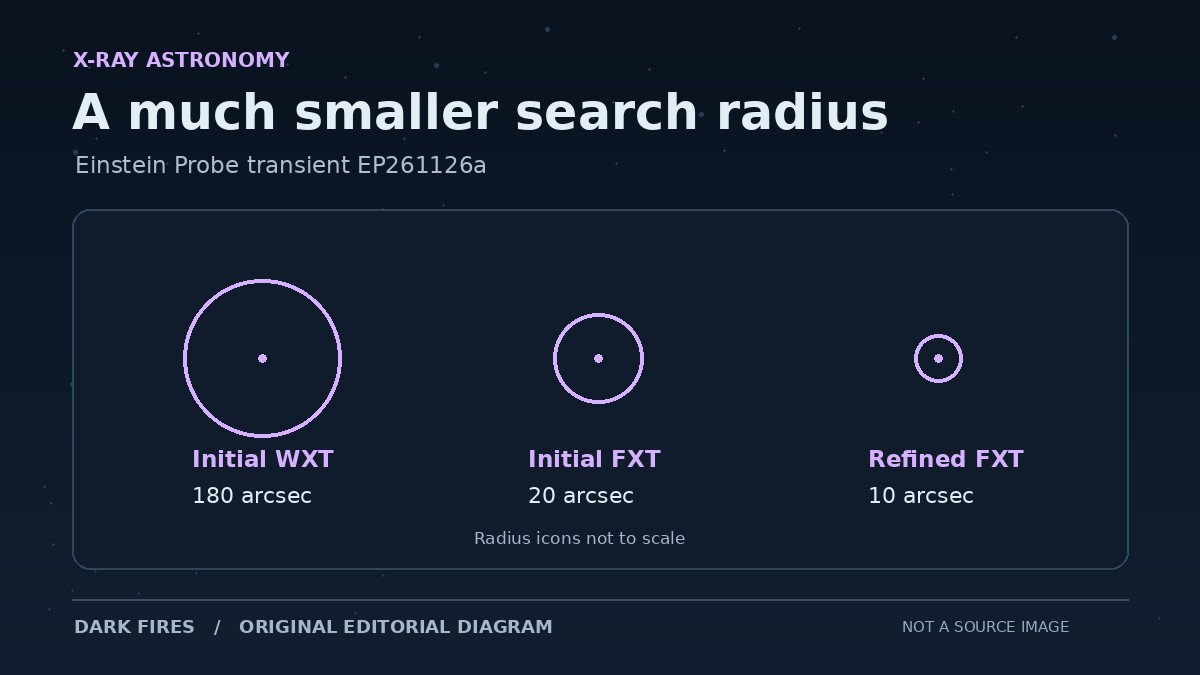
On November 26, Einstein Probe saw a brief X-ray event now called EP261126a. The team’s November 28 reanalysis made the patch of sky to search much smaller. It did not settle what produced the flash.
The team put the onset at 21:55:53 UTC, before the wide-field telescope triggered its alert at 22:04:27 UTC. The reanalysis describes weak initial emission followed by one bright pulse during about 500 seconds of wide-field data. Einstein Probe’s narrower Follow-up X-ray Telescope began observing at 22:07:59 UTC, about 12 minutes after the estimated onset.
The original wide-field alert gave a three-arcminute uncertainty radius. The first follow-up estimate was 20 arcseconds and the refined estimate about 10 arcseconds, all at the stated 90 percent confidence level. The refined radius is roughly one-eighteenth the size of the first one. That is a localization result; it does not give the flash’s distance.
The Nordic Optical Telescope and a Sun Yat-sen University infrared team found no credible new source in their observations within the areas they checked and down to their reported limits. Those are constraints at particular wavelengths and times. The X-ray team’s two instruments also averaged across different energy bands and intervals, so the published flux numbers should not be divided to get a clean fading rate.
Sources: Initial Einstein Probe bulletin · November 28 X-ray reanalysis · November 28 infrared limits
Leave a Reply