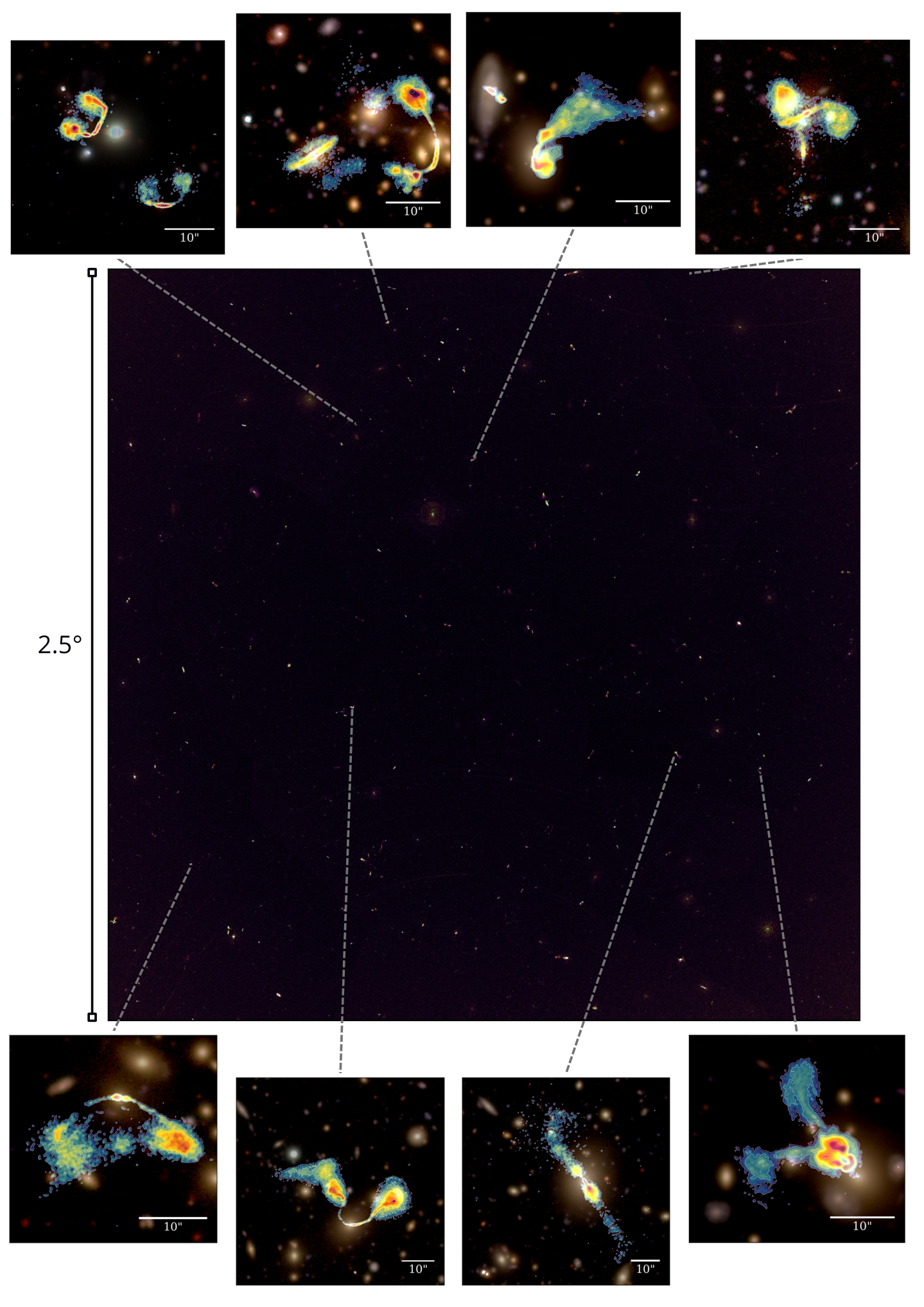
A new LOFAR image turns a crowded patch of radio sky into a much more useful map of galaxies and their activity. Announced on November 5, 2026, the work combines deep observations with enough angular resolution to separate structures that previously blurred together.
The research paper, posted November 4, describes 200 hours of observations between 115 and 168 megahertz across a field measuring 2.5 degrees on each side. Combining the new images with earlier, lower-resolution observations produced a catalog of 62,916 unique radio sources. The field is called ELAIS-N1.
What the extra detail reveals
A radio-bright patch can contain several different things: a compact galactic nucleus, an extended jet powered by an accreting black hole, or emission associated with star formation. Those possibilities matter because they describe different physical processes. A blurred source can also conceal more than one galaxy.
According to the Netherlands Research School for Astronomy’s announcement, the new view is about 20 times sharper than the previous most sensitive LOFAR image of this region. Its eight-billion-pixel image required processing roughly 400 terabytes of observations. Improvements in calibration and data reduction made that calculation practical, reducing computational costs by more than an order of magnitude in recent years.
The image is therefore an advance in measurement as well as presentation. Recognizing a jet’s shape allows researchers to investigate how it interacts with surrounding material. Distinguishing the host galaxy from a nearby source helps connect radio emission to measurements at other wavelengths.
Why several resolutions still matter
The paper reports a central resolution of roughly a third of an arcsecond. Yet the final catalog deliberately combines resolutions. Spreading faint emission across many small image elements can make an extended structure harder to detect, even while compact details become easier to separate. The sharpest image is not automatically the best image for every question.
The team has released the data for wider use. Matching these radio sources with optical, infrared and X-ray observations can help establish distances and physical properties. The institutional announcement says the results have been accepted by Astronomy & Astrophysics.
For readers, the useful distinction is between detecting more objects and understanding what produces their light. This project advances both, but its lasting value will come from the classifications and comparisons built on the map, rather than the source count alone.
Featured image: J. M. G. H. J. de Jong et al. (2026), Figure 2; LOFAR radio imaging with Subaru Hyper Suprime-Cam optical background. CC BY 4.0. Image source; license.
Leave a Reply