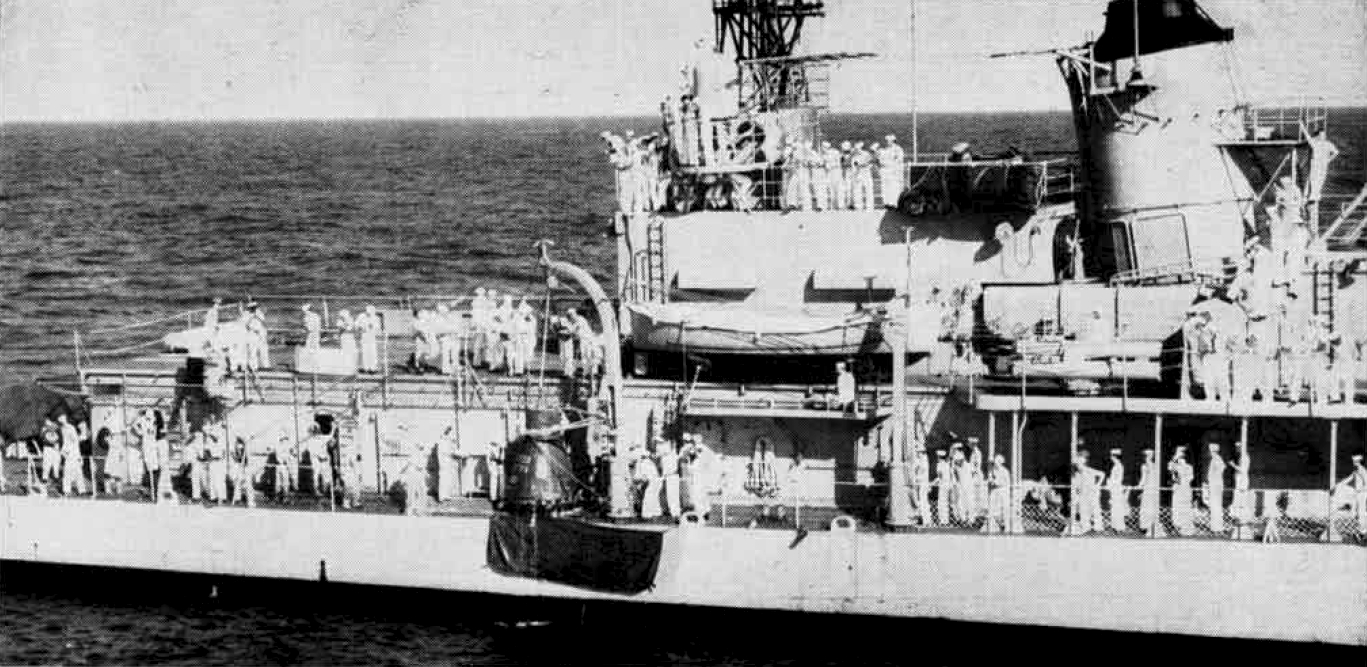
Image: USS Noa recovers John Glenn’s Friendship 7 capsule in the Atlantic Ocean on 20 February 1962. Mission context photograph, not an image of the reported particles. Credit: U.S. Navy, Naval Aviation News, April 1962, p. 7; via Wikimedia Commons. Public domain: official U.S. Navy government photograph Image source.

During his 20 February 1962 orbital flight, John Glenn observed bright particles outside Friendship 7. The episode is often remembered by its vivid nickname: “fireflies.” The name conveyed an appearance, not an identification of living creatures or visiting machines. A second Mercury mission supplied an unusually useful follow-up.
From surprise to a working explanation
NASA’s historical account describes the particles as ice traveling with Glenn’s spacecraft and illuminated near orbital sunrise. That is a retrospective identification, not necessarily what an observer could immediately conclude from the view through a capsule window. NASA’s Friendship 7 history provides the mission setting and distinguishes the phenomenon from the spacecraft’s separate operational difficulties.
On 24 May 1962, Scott Carpenter flew Aurora 7. His published flight report describes similar snowflake-like particles. During the third orbital dawn he accidentally struck the hatch and saw a cloud pass the window. He then deliberately knocked on the hatch and other spacecraft surfaces, repeatedly producing particles. Carpenter thought they reflected sunlight rather than generated their own light. His account appears on printed page 72 of NASA’s Results of the Second U.S. Manned Orbital Space Flight.
Why the follow-up matters
The key development was not that an authority supplied a mundane label. It was that an astronaut could change something locally and observe a repeatable result. A cloud arriving after contact with the capsule is evidence of a nearby source. That is more informative than the evocative resemblance to insects.
It is still important to state the scope correctly. Carpenter’s test did not chemically analyze every particle Glenn had seen months earlier. It provided a mechanism consistent with the earlier observations, while NASA’s later account identifies the familiar phenomenon as ice. That distinction allows the explanation to be strong without pretending that the two missions constituted a single controlled laboratory experiment.
The incident also illustrates why “moving with the spacecraft” need not imply active pursuit. Material originating near a vehicle can initially share much of its motion. From an unfamiliar viewpoint, small nearby particles may appear to accompany the observer. Relative motion describes a relationship; by itself it does not establish a guidance system or an intention.
A better model for investigating surprises
There is no need to diminish Glenn’s observation to explain it. He noticed something real and reported it. Carpenter’s later observation added a way to investigate the source. The chain is useful precisely because it preserves both the initial uncertainty and the later evidence.
For readers of historical UAP accounts, the lesson is practical. Look for descriptions of lighting, the observer’s platform, possible nearby material, and attempts to reproduce an effect. These details often carry more explanatory value than a striking nickname.
The Mercury fireflies remain a memorable spaceflight mystery, but not an enduring demonstration of an unknown vehicle. Their history shows how a puzzling observation can become better understood when the next observer has an opportunity to test a specific explanation.
Leave a Reply