
Image: Jimmy Carter’s official portrait, 31 January 1977. His UFO report was filed in 1973, before his presidency. Credit: The White House / Library of Congress, via Wikimedia Commons. Public domain, official U.S. federal government photograph Image source.

Jimmy Carter’s UFO report is a genuine archival document, but its existence does not establish an extraterrestrial explanation. The handwritten form offers something more precise: a named witness’s account, recorded years after an observation, with estimates and limitations that can still be inspected.
Read the form before the legend
The National Archives reproduces Carter’s International UFO Bureau report and identifies it as a record filed while he was governor of Georgia. The form is dated 18 September 1973. Carter entered October 1969 as the observation date and Leary, Georgia, as the location. He estimated an observation lasting ten to twelve minutes and described a bright, changing appearance. He indicated that no optical instrument was used and that he heard no sound. The two-page scan is the primary source for those statements.
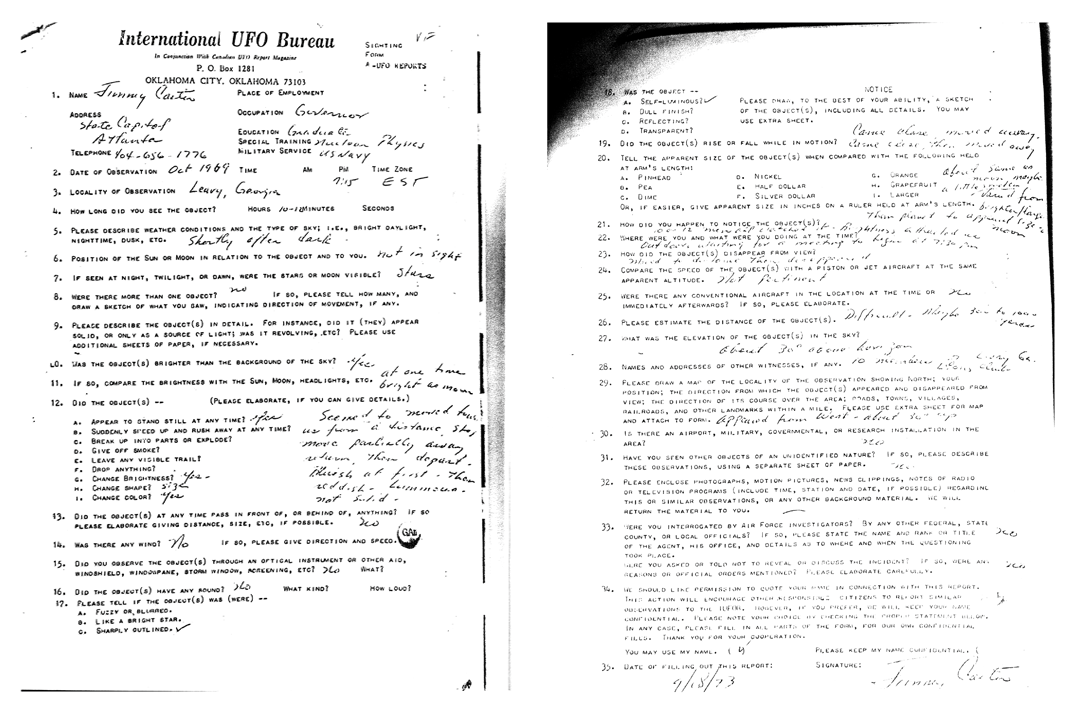
The distinction between the date written on a retrospective report and a securely established event date is important. This article preserves the date Carter supplied on the form; it does not treat the entry as independent verification of the precise night. Any proposed astronomical identification must first explain the chronology it uses.
An archive is not an endorsement
The National Archives guide to presidential-library UAP records directs readers to Carter material alongside many other types of correspondence and records. Archival custody establishes where a document is preserved. It does not mean the archive has certified the witness’s interpretation or endorsed every statement in the file.
This is an especially useful distinction when the witness later became president. Public office makes the report historically notable. It does not turn an unaided visual estimate into a calibrated measurement. Nor should a famous witness be dismissed simply because the account is inconvenient for one side of an argument. The appropriate standard is the same: identify what was observed, what was inferred and what can be checked.
What would a stronger explanation require?
A proposed identification would need a reliable time and location, the direction of observation, duration, relevant sky conditions and a comparison with possible sources. If a hypothesis depends on selecting one disputed date over another, that dependency belongs in the explanation, not in a footnote that readers are unlikely to notice.
The report also should not be made to claim more than its author recorded. An object described as bright, apparently changing color or seeming to approach is not automatically a structured machine. Perceived changes require assessment; they are not direct measurements of propulsion, composition or intent.
There is a difference between taking a witness seriously and adopting the most dramatic interpretation of the account. Careful reading honors the witness by retaining uncertainty, rather than replacing it with a conclusion that makes a stronger headline.
Carter’s form remains an accessible example of how UFO history can be studied without choosing between ridicule and sensationalism. It documents that he reported an unusual sight. On its own, it does not identify the cause. That modest conclusion is both historically meaningful and faithful to the evidence.
Leave a Reply