HD 158485 looks like a single point in ordinary observations and has been used as a calibration target for Webb. Gaia had already raised suspicion that it was a binary. A November 23 report from the Chinese Academy of Sciences explains how a team used TESS to work out the orbit by timing the stars’ own pulsations.
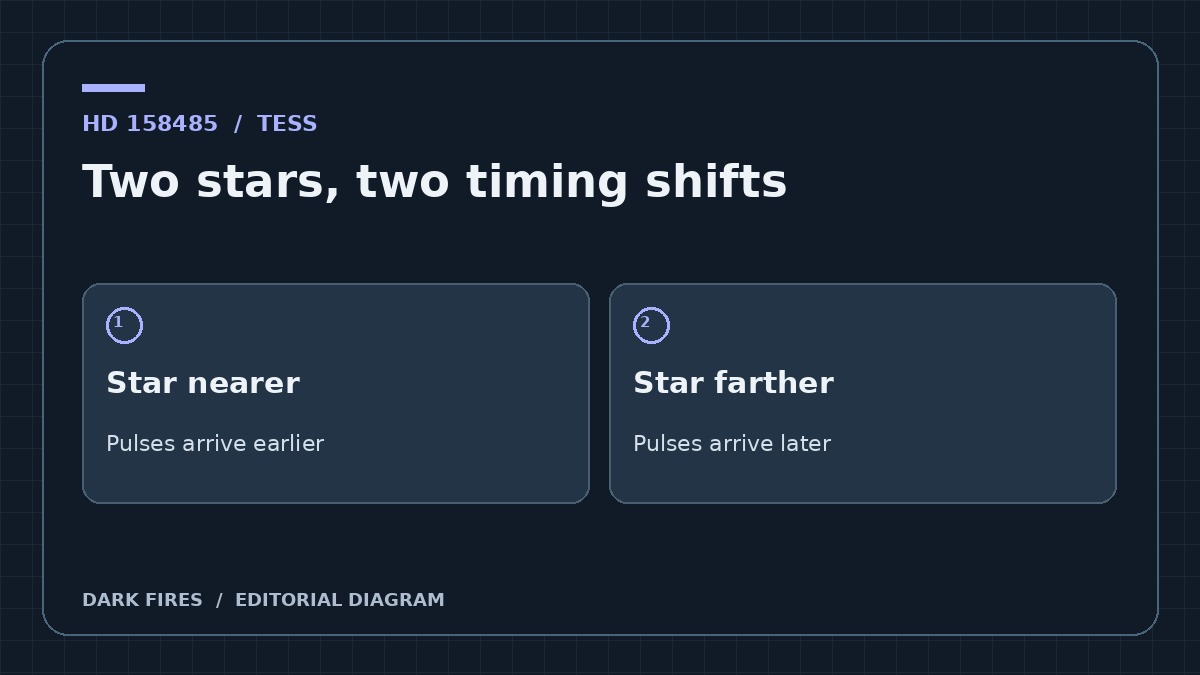
The team found six stable pulsation modes, split into two groups whose timing shifted in opposite directions. As a component moves closer, its pulses arrive earlier than expected; as it recedes, its pulses arrive later. The team fit a roughly 382.8-day orbit using the first two long observing campaigns and predicted the timing pattern in a third. That gave the model a check on data it was not fit to.
In the study, models of this target’s infrared brightness differ by about 1.6 percent across 1–5 micrometers and 2.5 percent across 5–28 micrometers depending on whether the model includes both stars. These are predicted differences for one calibration star, not measured errors in Webb data. The open manuscript describes the orbital fit and model comparison.
Leave a Reply