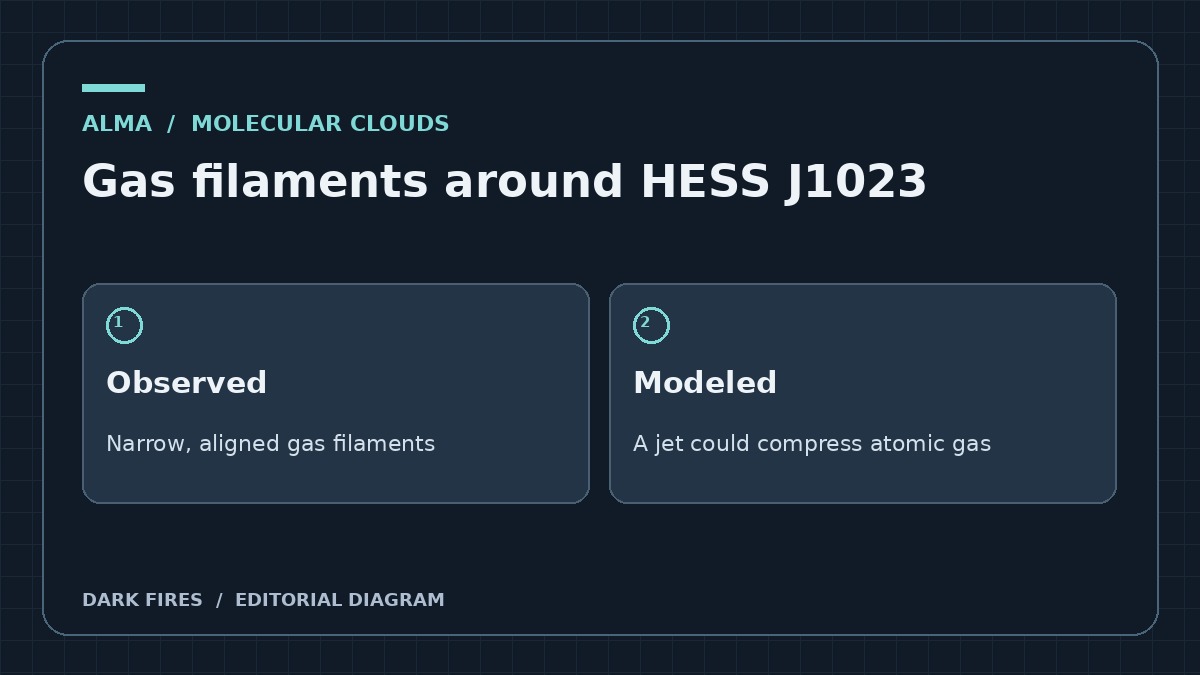
ALMA resolved narrow strands of molecular gas around HESS J1023−575, a high-energy gamma-ray source near Westerlund 2. Many strands line up along the axis of larger jet-like and arc-like clouds. At the distance assumed by the team, typical strands are about half a parsec across and 10 to 20 parsecs long. The paper appeared November 13, and ALMA Japan highlighted it November 26.
The filaments are the observation. The team’s simulations show how a jet could compress atomic gas and generate narrow molecular structures resembling them. That supports past jet activity as a possibility, but the observations do not directly show the compact object that would have driven it. The authors discuss a black hole or neutron star as possible engines.
The alignment gives astronomers a way to study past activity even if the engine is difficult to see. It does not establish a jet’s power from geometry alone. An estimate of energy in accelerated protons further depends on the assumption that particle collisions with surrounding gas account for the observed gamma rays.
Leave a Reply