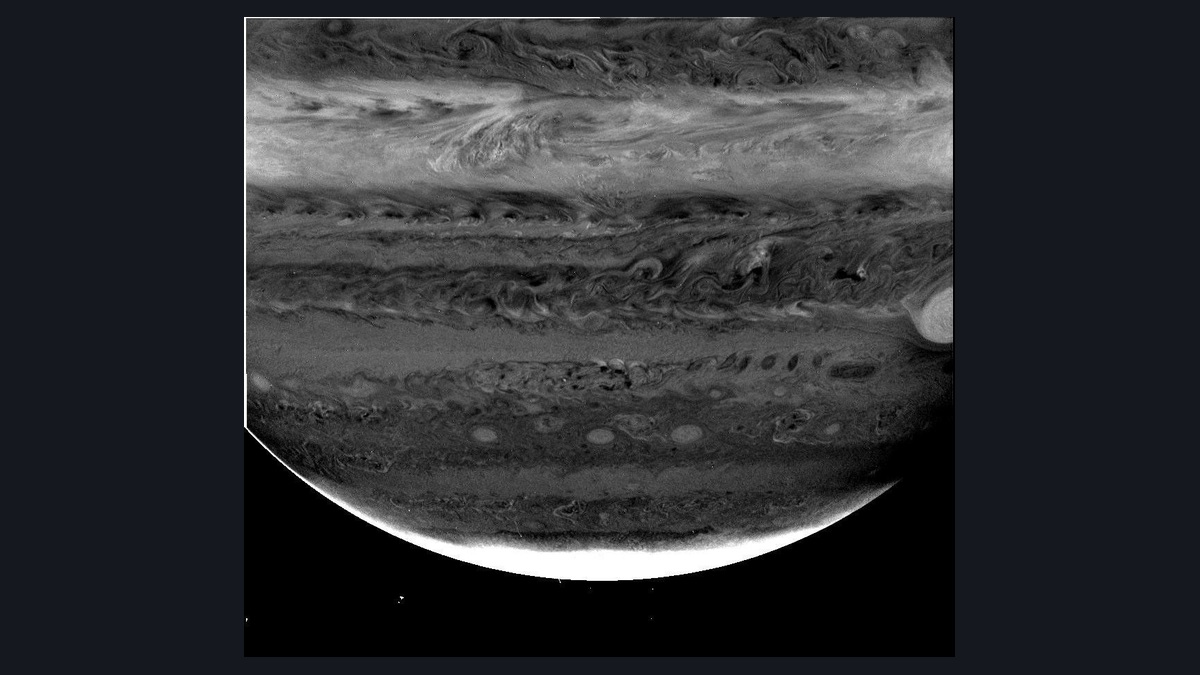
Cassini’s December 2000 Jupiter comparison puts the same region in three wavelength bands. At 619 nanometers, methane absorbs relatively weakly and deeper structures show through. At 890 nanometers, stronger methane absorption suppresses more of the light returning from deeper layers, making some high clouds and haze stand out.
The left and middle images divide each methane-band view by a nearby comparison image. The 890-nanometer panel is a strong-band image rather than a ratio. Our feature shows the middle panel only.
Look at Jupiter’s equatorial band in the three-panel source: it is subdued on the left but brighter on the right. The Cassini team interpreted this contrast as high haze above deeper layers. A bright patch in one panel alone is not an altitude measurement; the wavelength comparison is what makes it informative.
Featured image: Cassini’s 727 nm ratio image of Jupiter, middle panel of PIA02865. Credit: NASA/JPL/University of Arizona. Cropped from the original comparison.
Leave a Reply