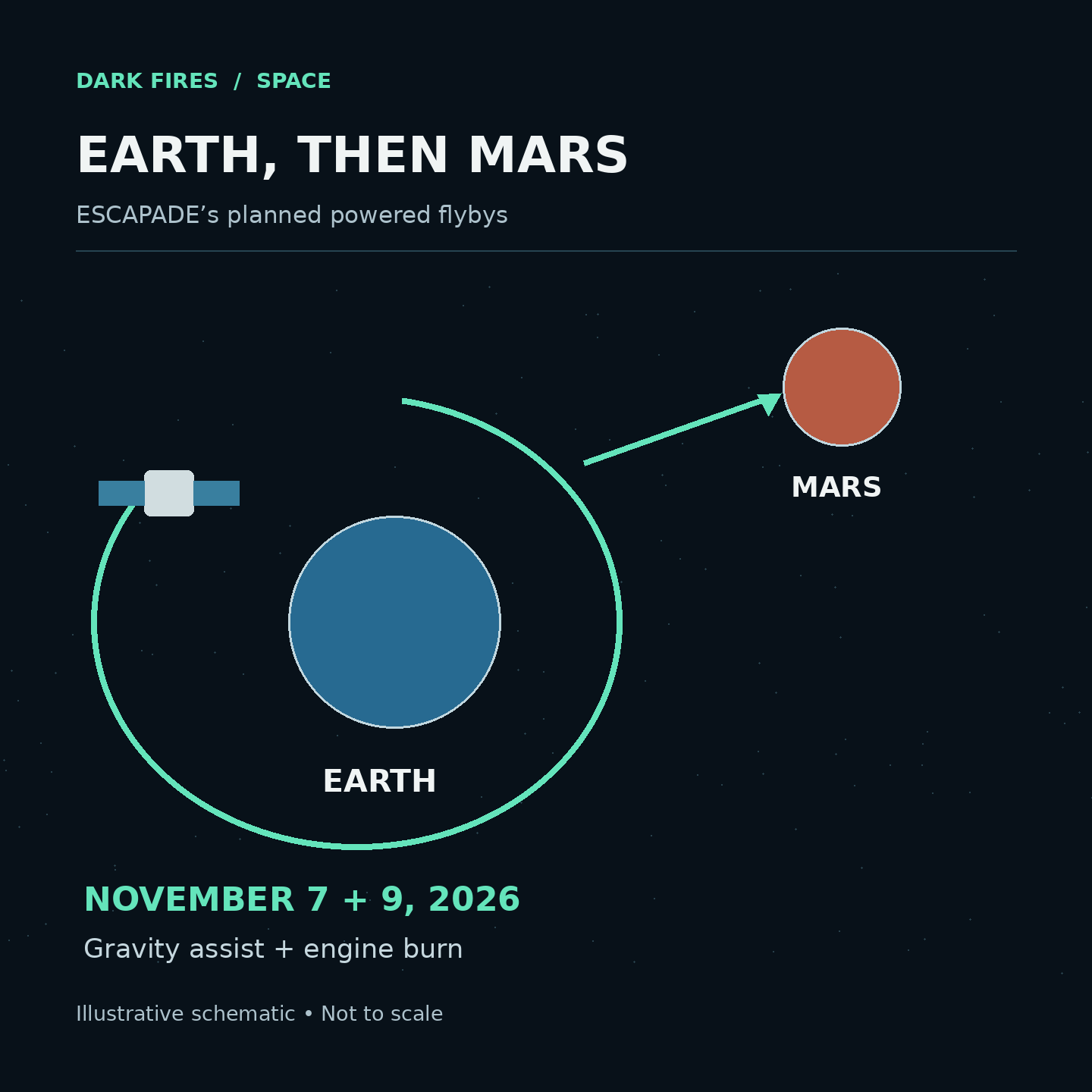
NASA’s twin ESCAPADE spacecraft have completed the powered Earth flybys that put them on course for Mars. The agency’s November 9, 2026 mission update confirms the maneuvers as completed events, marking a clear transition from the earlier observing opportunity and flyby preparations.
The first encounter took place around 5 a.m. EST on November 7, and the second around 6 a.m. EST on November 9. Each involved an approximately nine-minute engine burn. NASA reports closest-approach altitudes of roughly 1,000 miles and 650 miles respectively. The spacecraft are now expected to reach Mars in September 2027, with the main science campaign expected to begin in June 2028.
Those dates remain plans for the next stages of the mission. Completing the Earth departure does not mean that Mars orbit insertion or the subsequent science formations have already succeeded.
Why return to Earth to leave for Mars?
ESCAPADE’s route separates the launch from the final departure toward its destination. The spacecraft launched on November 13, 2025, then spent time in an Earth-proximity trajectory before returning for these encounters. Rather than treating the flight as a simple straight line between planets, mission planners used the changing geometry of the solar system as part of the propulsion strategy.
A powered flyby combines two effects: the gravitational encounter changes the trajectory, while an engine firing changes the spacecraft’s velocity. The result depends on timing and direction as well as thrust. A successful maneuver therefore represents more than simply switching on an engine; the spacecraft must arrive in the right place with the right orientation and flight conditions.
The broader operational question is whether such routes can provide useful flexibility for future missions. That does not mean every spacecraft can launch whenever convenient. Payload capability, propulsion, communications and the final destination still impose constraints. ESCAPADE now provides an actual completed departure against which this particular approach can be assessed.
Two viewpoints on a changing planet
The NASA mission overview describes ESCAPADE’s central objective as understanding how the solar wind interacts with Mars’ magnetic environment and contributes to atmospheric escape. Mars combines remnant crustal magnetic fields with fields associated with its interaction with the solar wind, creating a complicated environment for charged particles.
The planned observing strategy uses two spacecraft first in similar paths and later in different orbits. Following one another lets the instruments sample comparable locations at different times. Separating their viewpoints allows the mission to compare conditions in different regions at the same time, including the arriving solar wind and the planet’s response.
This addresses a basic measurement problem. With one moving observer, a change in a reading might mean the environment changed over time, or simply that the observer moved somewhere different. A second observer supplies an additional comparison. It does not remove every ambiguity, but it gives scientists a better chance of separating spatial structure from changing conditions.
Arrival is the next major test
NASA’s plan still requires course corrections, braking into Mars orbit and adjustment into the science configuration. Instruments that measure magnetic fields and charged particles will then have to turn paired observations into a coherent picture of how energy moves through the system.
For now, the immediate milestone is specific and substantial: both Earth flybys are complete. The mission has moved from waiting near Earth to interplanetary travel, while its most demanding Mars operations and its atmospheric-science payoff remain ahead.
Sources
Generated illustration
This schematic was prepared to illustrate the planned route before the flybys. It is not to scale and is not spacecraft photography.
Leave a Reply