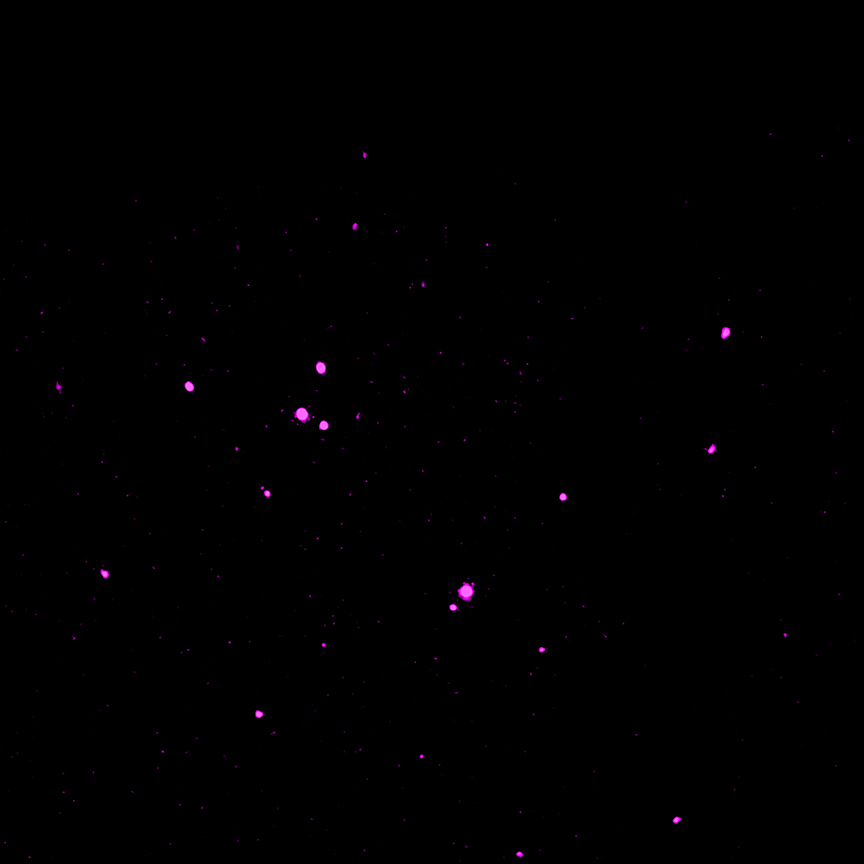
A star that repeatedly brightens without destroying itself appears to have a compact companion feeding its outbursts. New Chandra X-ray observations of AT 2016blu support a picture in which a neutron star or stellar-mass black hole captures material from its massive neighbor during close orbital approaches.
The findings were announced on November 9, 2026. The decisive observations were made in March, so the announcement reports an analysis of earlier measurements rather than an eruption newly seen this week.
AT 2016blu lies in NGC 4559, a spiral galaxy about 30 million light-years away. It belongs to a class of hot, unstable stars known as luminous blue variables. Its eruptions have earned it the description “supernova impostor”: it can brighten dramatically, but the repeated survival of the star distinguishes those episodes from a terminal stellar explosion.
Waiting for the right moment
The research paper’s publicly available abstract reports 27 observed outbursts between 2012 and June 2026, recurring approximately every 113 days. The team used optical monitoring around an expected eruption to trigger five closely spaced Chandra observations in March.
Earlier Chandra data from 2001 and 2002 had not detected the source. The new observations did, providing evidence that a compact object was accreting material. The researchers interpret the repeating episodes as encounters near the closest points of an elongated orbit.
According to NASA’s release, the March source was at least 100 times brighter in X-rays than the earlier measurements allowed. Material captured by a neutron star or black hole can become extremely hot as it falls inward, producing the high-energy radiation that revealed the otherwise hidden partner.
The companion’s identity remains open
The observations do not yet establish whether that companion is a neutron star or a black hole. Both remain possible explanations. The secure distinction is between the observed X-ray brightening and the physical model used to explain it.
The system also illustrates why timing and image resolution matter. An observation taken only between eruptions could miss the behavior that explains the system. Chandra’s ability to separate nearby X-ray sources was important because another bright source appears close to AT 2016blu on the sky.
The Chandra image release explicitly identifies that brighter neighboring source as unrelated to AT 2016blu. A bright spot in an astronomical image is therefore not automatically the object responsible for the event under investigation.
A connection worth testing
The results suggest a possible relationship between some violent stellar outbursts and accretion onto compact companions. That could help astronomers interpret other unstable stars and unusually luminous X-ray systems.
For now, AT 2016blu offers a particularly useful case: a repeating optical signal, a targeted high-energy observation and a physical explanation that can be tested against future eruptions. Further monitoring can examine how consistently the X-rays track the optical cycle and help narrow down the nature of the unseen companion.
Featured image: Chandra X-ray view of the field containing AT 2016blu, based on March 2026 observations. Credit: NASA/CXC/Univ. of Virginia/M. Aghakhanloo et al.; image processing: NASA/CXC/SAO/P. Edmonds.
Leave a Reply