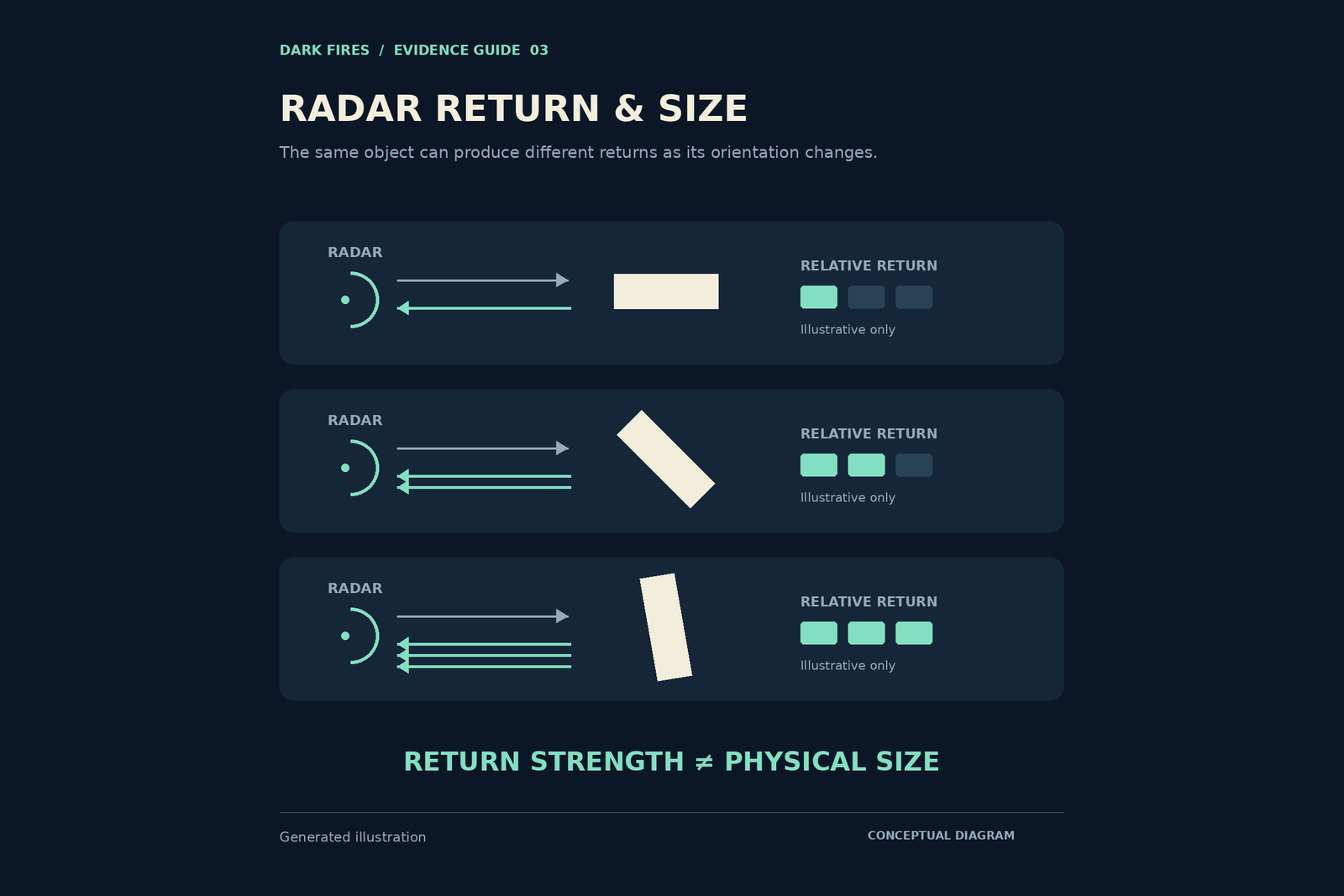
A report describes an unidentified radar target as “large.” Before treating that word as a measurement of a large craft, ask what was actually measured. Radar cross-section describes how a target scatters radar energy back toward the receiver. Although it is expressed using area units, it is not a straightforward measurement of wingspan, diameter or surface area.
An electromagnetic measurement
The National Weather Service glossary defines radar cross-section through a hypothetical reflector that would return the same amount of energy as the real target. The comparison describes the radar response, rather than tracing the outline of the object.
A useful distinction follows: “the return resembles that of a larger object” is not equivalent to “the object has those dimensions.” Converting one into the other requires assumptions about the target and the observing system.
Why the same object can produce different returns
A NASA-hosted study of spacecraft materials identifies several influences on radar cross-section, including physical dimensions, orientation relative to the radar, observing frequency and material properties. It also explains that a measured cross-section can correspond to more than one physical size.
NASA’s orbital-debris work therefore uses a size-estimation model informed by laboratory measurements. This is a useful example of the missing step in casual claims about radar targets: researchers do not simply relabel a return-strength measurement as a diameter.
For an unidentified target, ask what model was used and why its assumptions fit the object. If its material and orientation are unknown, those uncertainties should remain visible in the resulting size estimate.
A bright patch is another separate quantity
NASA JPL’s imaging-radar explanation distinguishes returned signal strength from image resolution. Its discussion of normalized radar cross-section specifically separates that measure from pixel size. A large-looking patch on an image should therefore not be read directly as an object’s physical outline.
This does not make radar evidence unhelpful. It means that the meaning of a displayed feature depends on the instrument, product and processing. A screenshot stripped of its scale and product information may omit the details needed to interpret it.
Questions to ask about a “large radar target”
- Does “large” mean strong return, broad display symbol, estimated dimensions or something else?
- Is there a numerical measurement with units, or only a verbal description?
- Which radar, operating mode and frequency produced it?
- Was size inferred through a stated model, with uncertainty?
- Is the original data available, or only a photograph of a display?
A careful report keeps the observation and inference separate: “The instrument recorded a strong return; physical dimensions have not been established.” When a size estimate is justified, publish its assumptions alongside it. That makes the evidence more useful without asking a radar measurement to answer a question it did not directly measure.
Generated illustration
The featured schematic is conceptual and does not depict measured radar data.
Leave a Reply