A detector labels a sky photograph “likely real.” Does that establish that an unusual object was present? Even a correct assessment of how the pixels were produced would leave several questions unanswered: where the picture was taken, what it depicts, and whether the accompanying story is accurate.
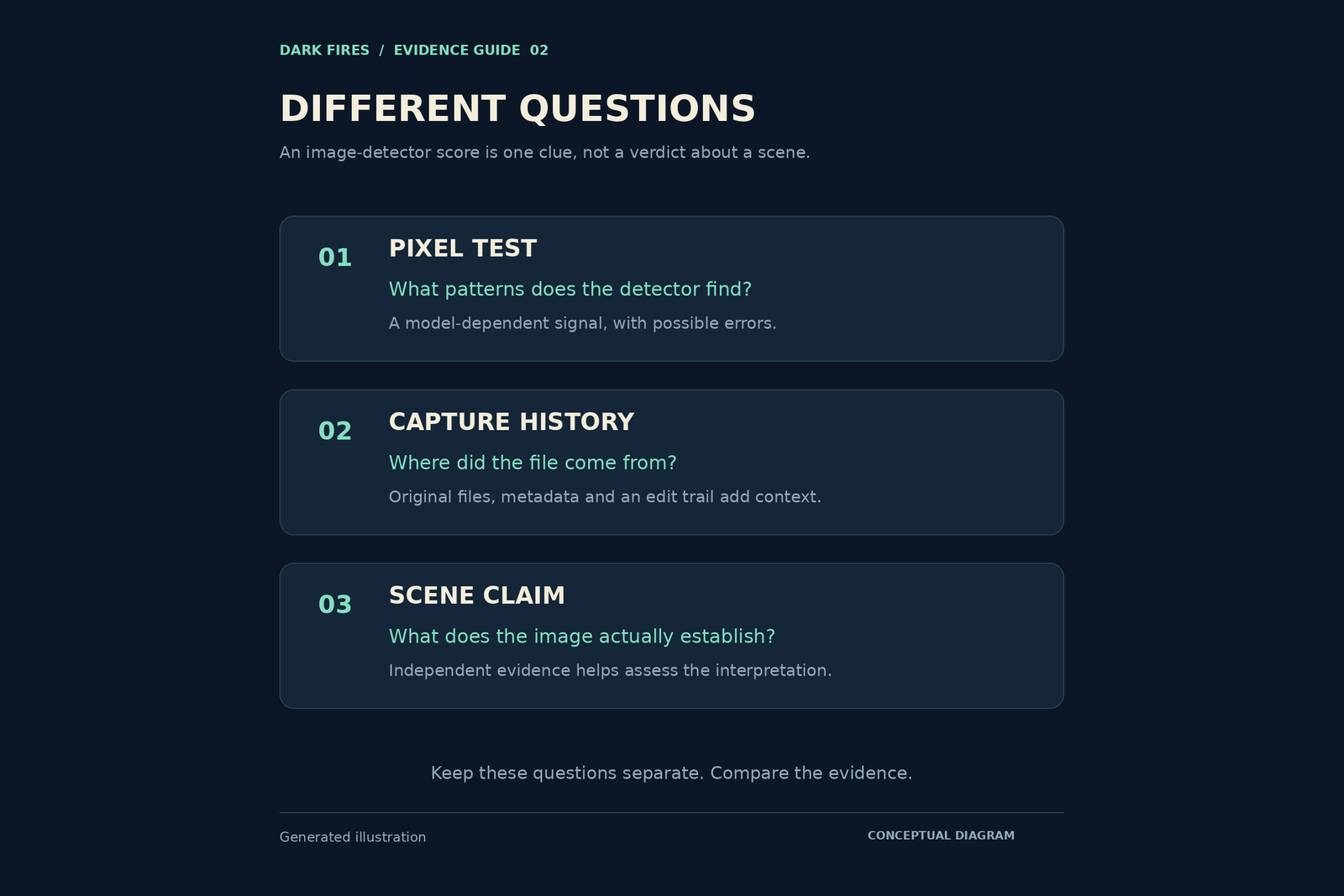
For UAP investigations, it helps to separate three claims: the file was not generated by AI; the file records the reported scene; and the object has been identified correctly. A result addressing the first claim cannot settle the other two.
Understand the test before trusting the score
NIST’s report on synthetic-content transparency describes detection as one part of a broader toolkit. Its image-detection discussion notes that performance varies with the evaluation images, their subject matter and their processing. Detectors can perform better on generators represented in their training than on unfamiliar ones. Compression and resizing can further complicate evaluation.
That matters when a system tested on portraits is presented with a small light against a dark sky. Ask whether its published testing covers comparable images and how it handles uncertain cases. Do not assume a displayed percentage has been validated for this particular kind of evidence.
Record the tool name, test date, file tested and exact output. A detector result should be reproducible enough to discuss, rather than reduced to a screenshot saying “verified.”
Provenance answers a different question
Content Credentials can provide records about a file’s creation and editing history. The C2PA FAQ describes signed, tamper-evident provenance data and explains that credentials can become separated from their associated media. Consequently, missing credentials are not, by themselves, evidence of fabrication.
The C2PA explainer also makes an important distinction: provenance information alone cannot determine whether content is true, accurate or factual. A documented capture history does not automatically validate a caption’s claim about an object.
Use a claim-by-claim review
Begin by writing down what the photograph is being offered to prove. “A camera recorded this light” requires different support from “this light performed an impossible maneuver.” A single still image cannot establish a maneuver merely because it passes a synthetic-image test.
Then build a short evidence record:
- Identify the earliest available source and distinguish it from later reposts.
- Compare the claimed place with visible buildings, terrain or other fixed details.
- Ask for the capture file and adjacent photographs, where available.
- Keep detector findings separate from provenance findings and scene interpretation.
- State explicitly which claims remain unsupported.
For example: “The detector did not flag this file, but the location and object identity remain unverified.” This wording preserves the useful result without turning a limited technical test into a certificate of authenticity. Neither automatic rejection nor automatic acceptance is a substitute for checking the claim the image is supposed to support.
Generated illustration
The featured diagram separates different evidence questions; it is not an assessment of an actual image.
Leave a Reply