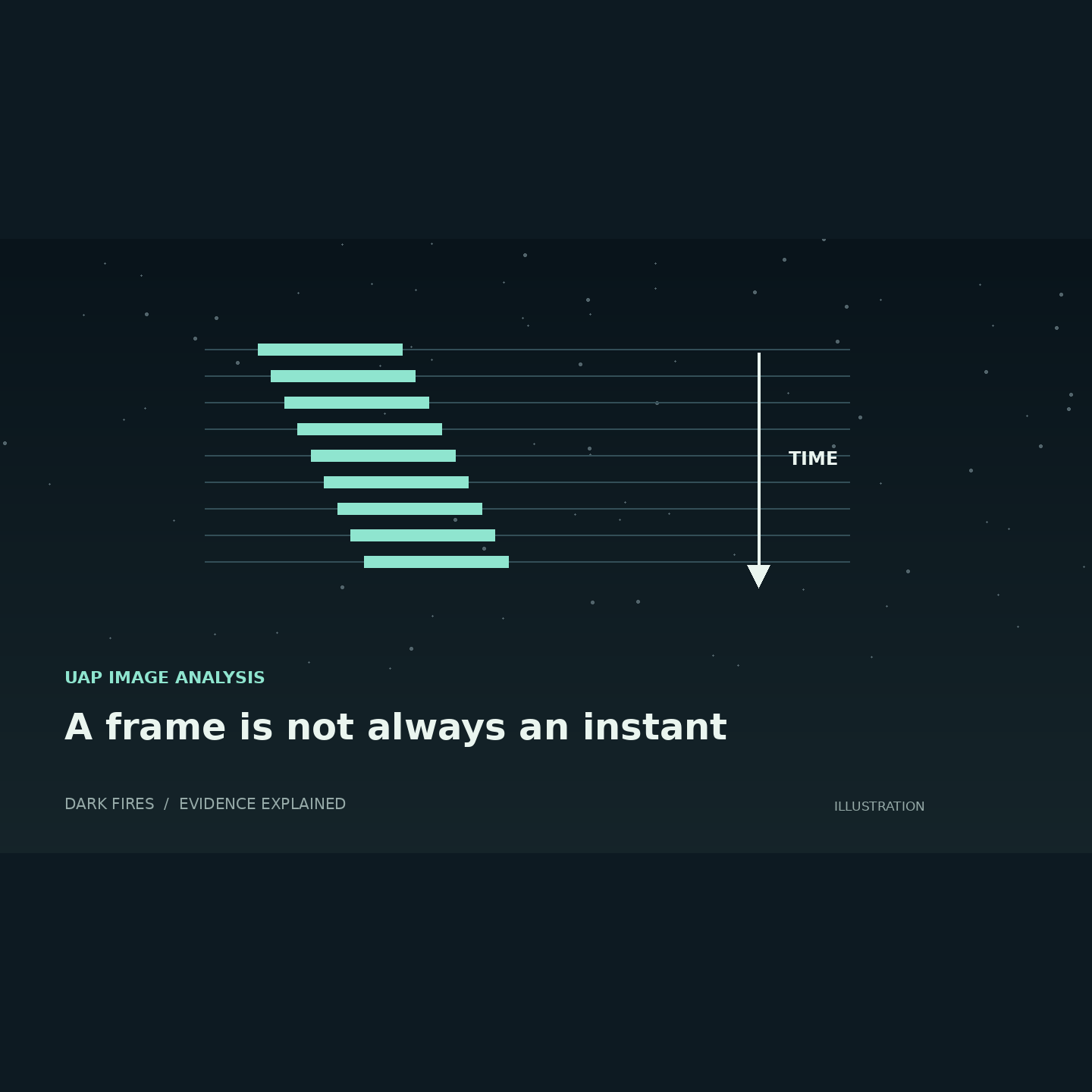
A strange outline in a UFO video may be an important observation. It is not automatically the outline of a strange object. Before measuring a bent, stretched or slanted shape, investigators need to know whether the camera recorded the whole scene at once.
With a rolling shutter, different rows of the sensor begin their exposures at different times. Basler’s camera documentation describes this row-by-row offset and explains that movement of either the subject or camera can distort the result. The finished frame combines measurements made across an interval, rather than one perfectly shared instant.
Sharp does not necessarily mean undistorted
Imagine a straight vertical marker moving sideways while the sensor scans downward. Its upper portion is recorded earlier than its lower portion. Combining those strips can produce a slanted marker, even though the real object never bent. This is a conceptual example, not a reconstruction of any reported encounter.
There are two separate timing questions: how long each row collects light, and how far apart the rows are in time. A short exposure can reduce motion blur without removing the second effect. Axis’s August 2026 technical white paper illustrates that distinction with rapidly moving objects and propellers. It also explains why a brief flash can illuminate only a band of a rolling-shutter image.
For a UAP clip, this means that crisp edges are not sufficient evidence that the shape is geometrically faithful. It also means that a distorted propeller is not proof that an entire object has changed shape. Claims must identify which feature is being measured.
A testable camera explanation
Start with the camera model and the actual recording mode. Do not assume every camera uses the same sensor timing, or that every mode on one device behaves identically. Basler notes that row timing varies between camera models. Preserve the full recording, including moments when the camera moves across recognizable background features.
Then ask whether the proposed explanation predicts the observed pattern. If a quick pan coincides with slanted background structures and a skewed target, that is a useful clue. If the suggested distortion requires motion that the clip does not support, simply naming rolling shutter has accomplished little. A comparison recording made with the same device and mode can help test the idea, provided it is clearly labeled as a test.
A corrected-looking image is not independent confirmation. Any correction introduces assumptions about camera motion and timing. Publish those assumptions alongside the processed result, keep the untouched source available, and avoid treating an aesthetically convincing reconstruction as a recovered ground truth.
Rolling shutter is one specific mechanism with specific conditions. It cannot be invoked to dismiss every unusual video. Its value is narrower and more useful: it tells us which apparent shapes need a camera-timing check before they become claims about an object’s structure or behavior.
Featured image: Generated illustration. Original Dark Fires explanatory diagram, not sighting footage.
Leave a Reply