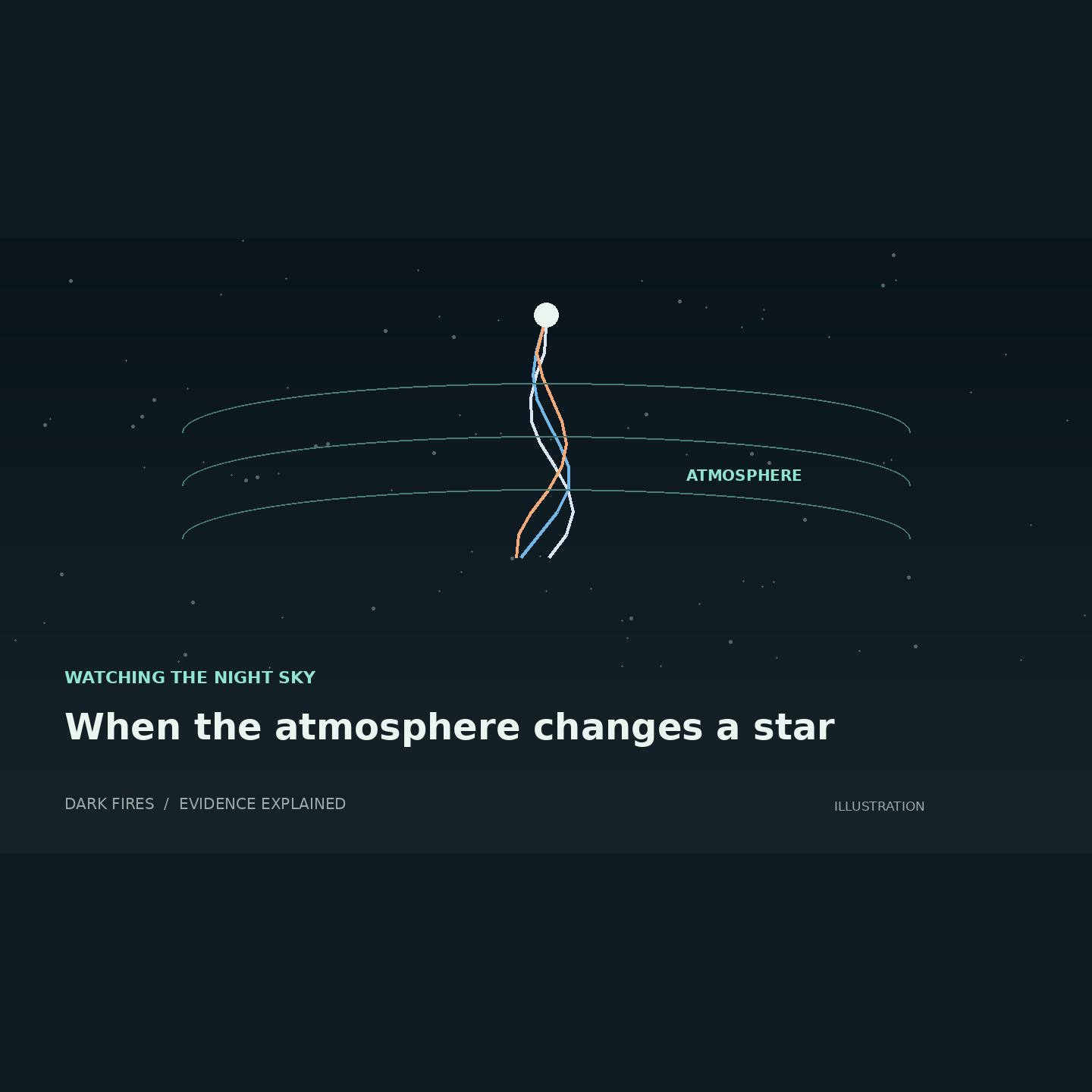
A bright point hangs low in the sky, flickering and changing color. Those are real visual observations, but they do not necessarily describe a light source changing its own output. The air between the observer and the source can produce some of the variation.
The World Meteorological Organization’s International Cloud Atlas defines scintillation as rapid fluctuations in light from stars or terrestrial sources. Changing atmospheric refraction can affect apparent brightness, color and position. Other conditions being equal, a longer atmospheric path produces stronger scintillation, which is why stars near the horizon tend to twinkle more strongly than stars overhead.
The atmosphere is part of the observation
NASA’s October 2000 StarChild explanation describes how moving air bends incoming starlight so that different amounts reach an observer. The familiar word “twinkle” can sound too gentle for a report of rapid colored flashes, but the WMO description explicitly includes color changes.
This is not a license to identify every flashing light as a star. The WMO definition also includes terrestrial lights. More importantly, knowing that scintillation exists does not establish that it explains a particular observation. The source’s position and behavior still need to be tested against the record.
Consider a hypothetical report of a red-and-blue point above a distant roofline. The color sequence alone cannot distinguish a changing emitter from changing atmospheric transmission. If a proposed stellar identification places the star in the wrong part of the sky at the recorded time, the identification fails even though the physical mechanism is real.
Make the next observation more useful
Record the date, local time with time zone, observing location, direction and approximate height above the horizon. Include the duration. A close-up may reveal flickering, but a wider view containing fixed landmarks helps another person reconstruct where the light was seen.
Compare the suspected source with nearby known stars without changing the basic observing conditions. Are several points fluctuating? Does one stand out? Record the comparison rather than compressing it into “everything else was normal.” An absence of obvious twinkling in neighboring objects is information to retain, not a final verdict.
If consulting a sky chart, set the correct place and time before selecting a bright candidate. Treat the match as a hypothesis to check against the entire account. A source identified only because it was the brightest available star is a weak match. A source fitting direction, elevation and the observation’s timeline offers a more useful test.
It is equally important to preserve features that do not fit. A reported rapid journey across the sky is a different claim from a point’s small apparent fluctuations. Do not let a general discussion of twinkling silently replace the witness’s more specific description.
Scintillation gives investigators a concrete atmospheric explanation to evaluate, especially for low, bright, changing-color points. Its greatest benefit is not an instant answer. It is a better question: how much of the observed variation belonged to the source, and how much could have been introduced along the light’s path?
Featured image: Generated illustration. Original Dark Fires atmospheric-light schematic, not a sighting photograph.
Leave a Reply