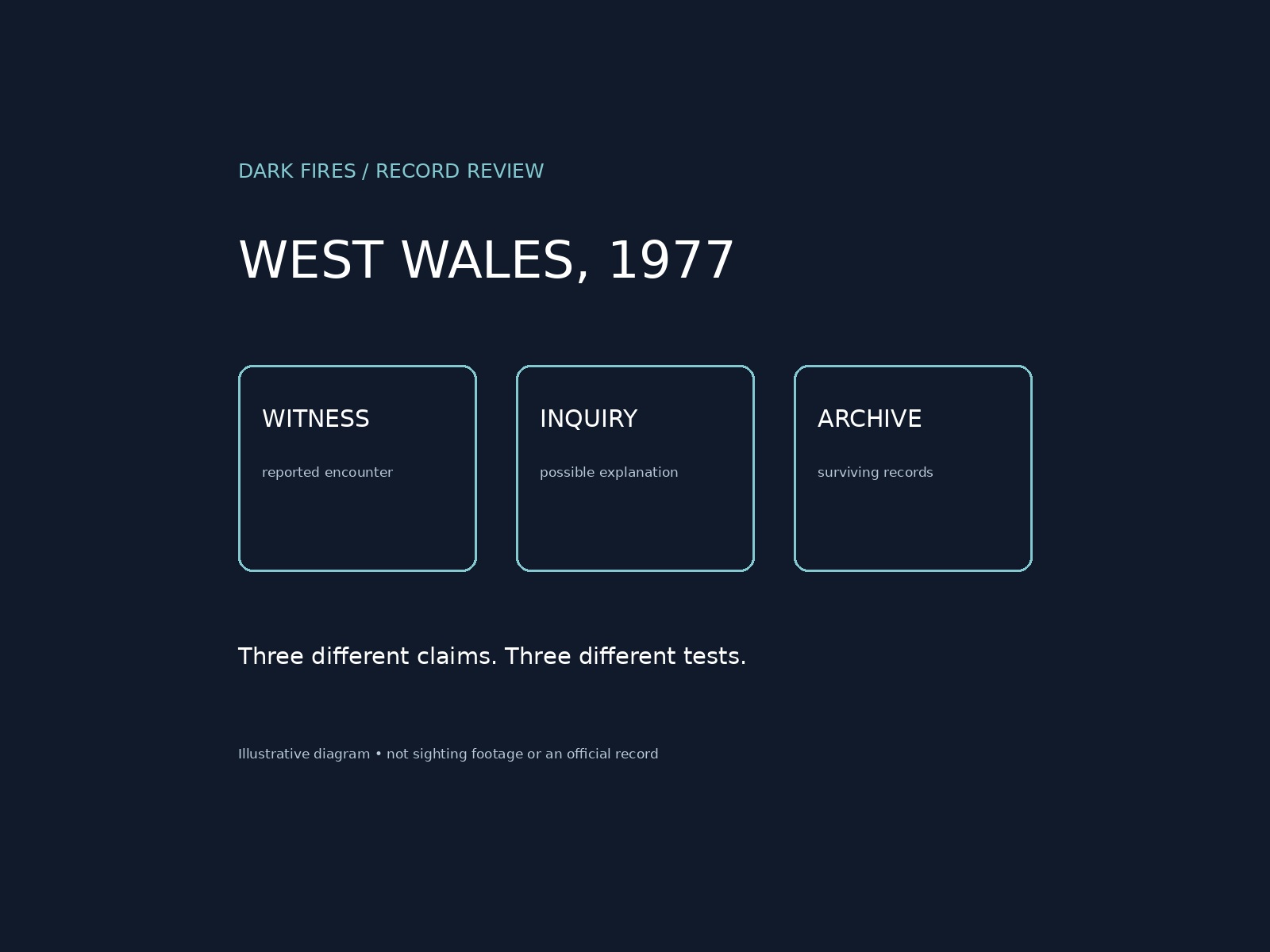
A UFO wave is not a single observation. West Wales in 1977 provides a useful test of that distinction: a possible explanation for reports of silver-suited figures is not automatically an explanation for every light or object reported in the region.
This is a historical record review, not a newly released case. In its July 2012 release commentary, The National Archives described papers concerning Pembrokeshire sightings in 1977–78. Historian David Clarke recounted a hotel proprietor’s report, passed through MP Nicholas Edwards, and an RAF interview and follow-up inquiries.
What the inquiry suggested
According to that archival commentary, RAF police suspected someone had borrowed a firefighting suit from a local display and walked around at night. Its appearance offered a possible explanation for some humanoid reports. The commentary explicitly did not describe the entire regional wave as solved.
The evidential boundary matters in both directions. An official inquiry shows that a report received attention; it does not verify the reported visitors. A suspected practical joke supplies a hypothesis, not proof that every witness encountered the same person. Treating a collection of reports as one event erases the differences investigators need to test.
Missing records are a separate issue
A Dyfed-Powys Police response disclosed on October 10, 2022 said it held no information responsive to a request for Broad Haven’s 1977 UFO reports because its records did not extend that far back. That is a statement about retention, not a finding that nothing happened or nobody reported anything.
Meanwhile, a 2015 parliamentary answer directed researchers seeking files on the 1977 West Wales sightings to The National Archives. Different institutions can therefore yield different answers without contradicting one another: they preserve different record sets.
A careful reconstruction should keep individual dates, witnesses and locations separate, then attach each explanation to the report it actually addresses. Neither an unresolved remainder nor a plausible hoax elsewhere establishes what a particular witness saw. The durable lesson of the Welsh files is methodological: compare claims at the scale the evidence can support.
Featured image: original illustrative diagram by Dark Fires; not an archival document or a reconstruction of a sighting.
Leave a Reply