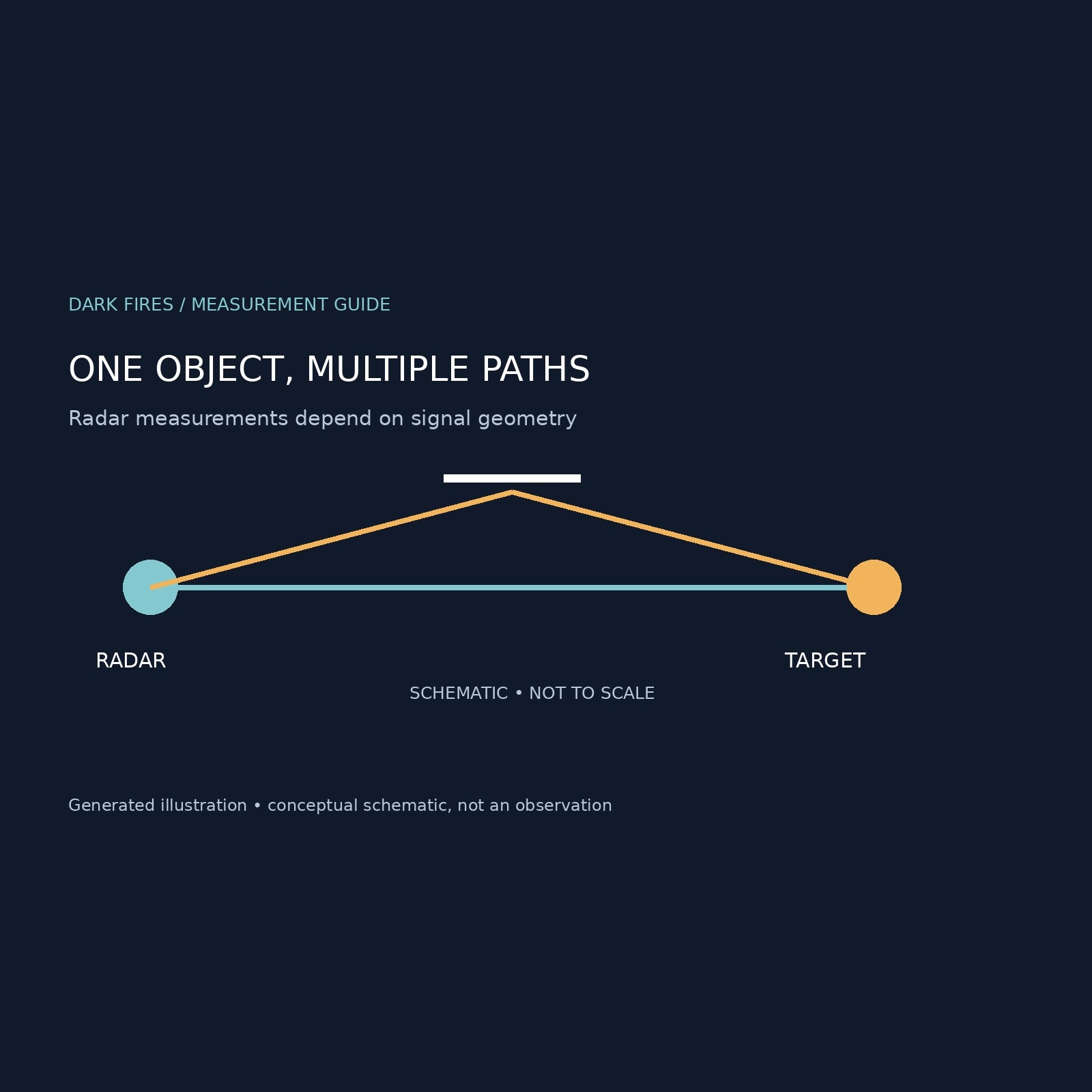
A radar return is a measurement of a signal’s journey, not a photograph of an object. If that journey includes an extra reflection, the displayed detection can appear somewhere the physical target is not.
MathWorks’ radar-engineering demonstration models this effect with a vehicle and a roadside barrier. In one two-bounce path, the echo arrives from the target’s direction but travels farther than the direct return, creating an apparent target at a greater range. In another, the echo arrives from the reflecting surface’s direction. A three-bounce path produces a mirror-like ghost beyond the barrier.
The example is an automotive simulation, not an analysis of a military UAP encounter. Its relevance is methodological: counting radar detections is not automatically equivalent to counting physical objects. The geometry of nearby reflectors and the sensor’s processing matter.
A credible UAP analysis would therefore need the radar configuration, environmental geometry and original measurements before invoking or excluding multipath. Showing that ghosts are possible neither proves a particular return was false nor establishes an extraordinary craft. It identifies a testable alternative.
Primary source: MathWorks radar multipath demonstration
Featured image: Generated illustration. Conceptual schematic, not an observation.
Leave a Reply