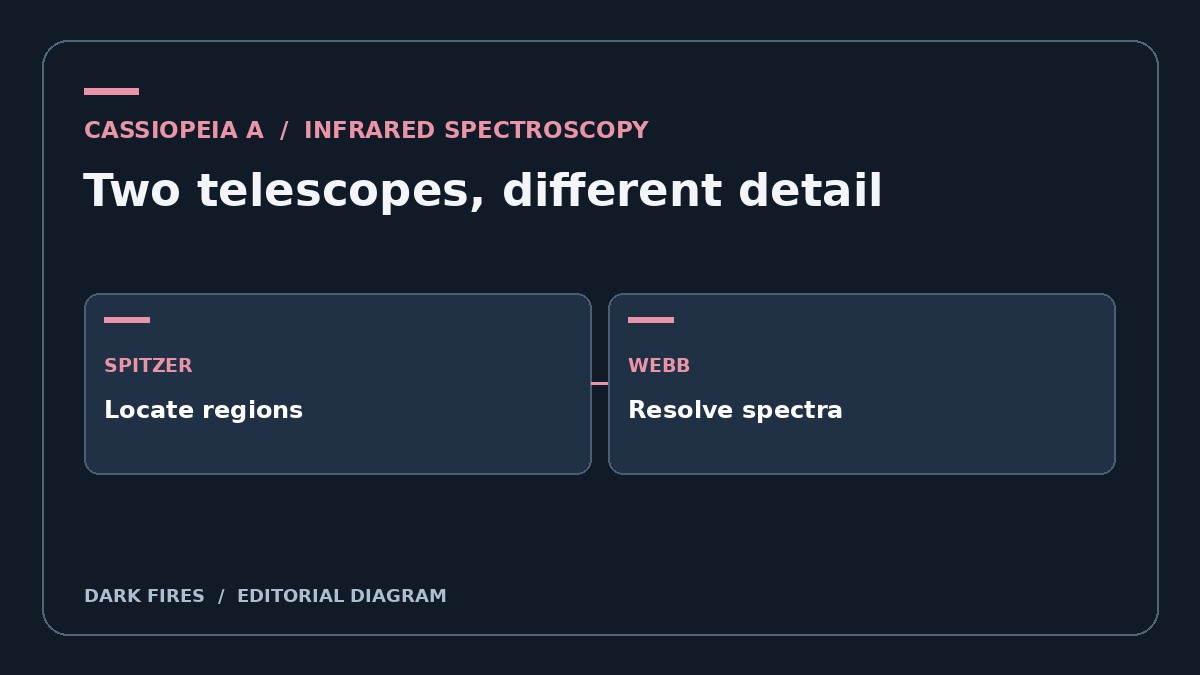
NASA’s retired Spitzer telescope helped identify three regions of the Cassiopeia A supernova remnant for a closer look. In a November 23 release, NASA describes how Webb’s infrared measurements let astronomers examine the dust in those regions in more detail.
Two targets lay where a reverse shock meets debris from the explosion. Webb’s spectra indicated mostly silica dust in one and mainly carbon dust in the other. The third target, nicknamed the Green Monster, contained complex magnesium silicates. That structure traces material the star shed before it exploded, unlike the other two targets. The result distinguishes three deliberately selected regions; it is not a tally of the dust throughout Cassiopeia A.
Astronomers make these comparisons by examining broad signatures in the infrared spectra, not by reading the colors of a composite picture. The difference between the two ejecta regions gives researchers a way to test how material from different layers of the original star mixed before it exploded. Webb’s mission overview provides more context for the infrared observations.
Leave a Reply