A detector that recognizes most examples of a rare class can still produce many false alerts. Its sensitivity answers one question: how often does it flag a genuine example? An investigator usually needs the reverse: among the alerts, how many are genuine?
Count the ordinary events too
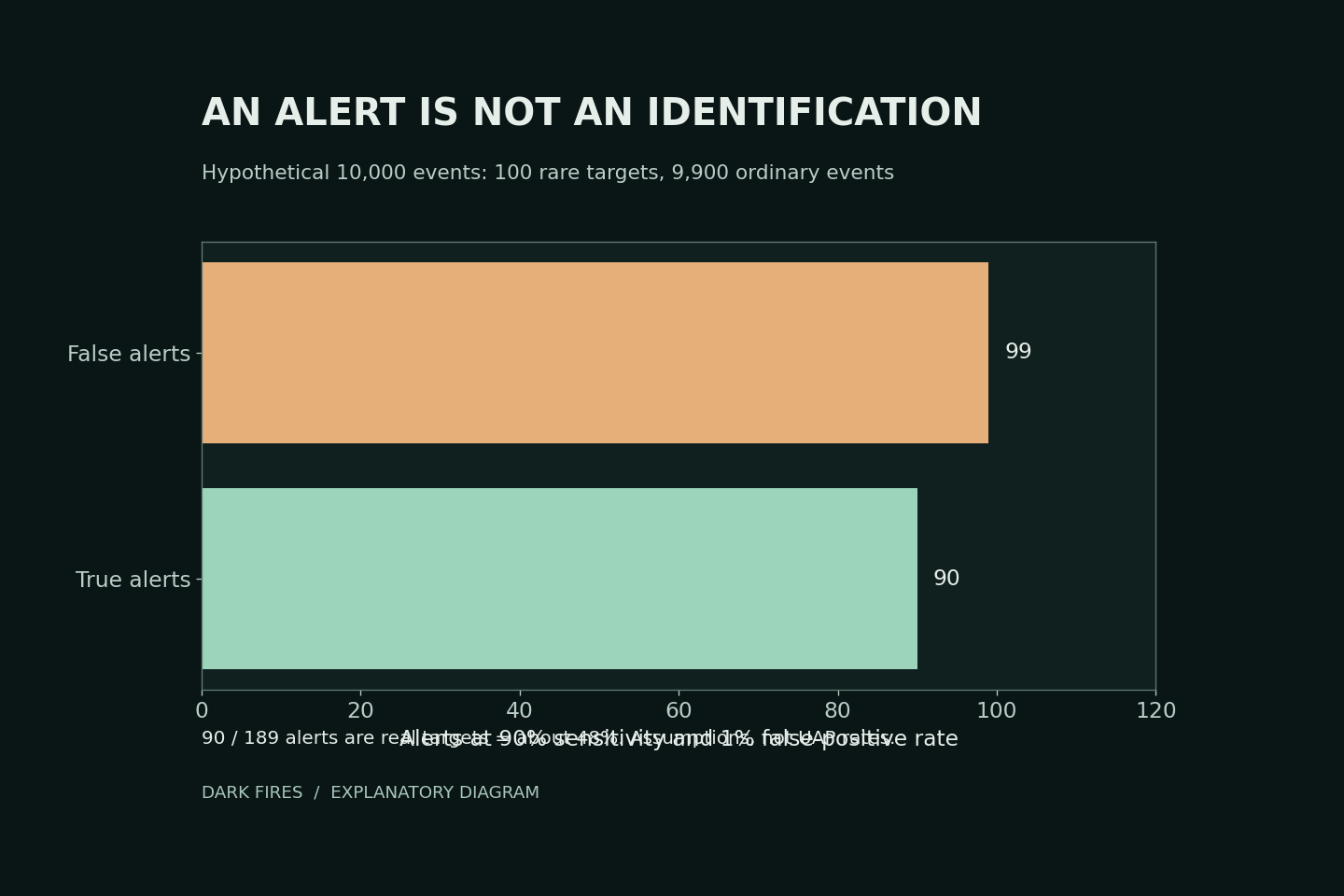
Consider 10,000 hypothetical events: 100 belong to a target class and 9,900 do not. A detector with 90% sensitivity flags 90 target events. A 1% false-positive rate also flags 99 ordinary events. Only 90 of the 189 alerts, about 48%, belong to the target class.
These invented numbers do not estimate alien activity, unidentified objects or the performance of any actual UAP system. They demonstrate why the prevalence of the target class matters.
What Bayes’ theorem changes
UCAR’s probability documentation explains how Bayes’ theorem combines a prior probability with the likelihood of an observation. Reversing a conditional probability requires that additional information; the detector’s sensitivity alone is insufficient.
For a real monitoring program, report performance against known examples and ordinary controls, explain how the sample was selected, and show how conclusions change across plausible prevalence assumptions. An unknown base rate should remain an uncertainty, not be replaced with a convenient number.
Finally, define the target class. An alert for “unusual image” is not a validated detector for “extraterrestrial craft.” Good arithmetic cannot repair an unsupported change in what the classification means.
Primary technical source: UCAR on conditional probability and Bayes’ theorem.
Generated illustration. Original Dark Fires chart of the hypothetical example above, not observational UAP statistics.
Leave a Reply