A planet can disappear from a telescope’s transit record without going anywhere extraordinary. TOI-2535 b has provided a particularly striking example: over seven years, its crossings of its star grew shorter and shallower before no longer being visible from Earth.
The study posted on November 9, 2026, and published in The Astrophysical Journal Letters, identifies it as the first confirmed planet around a single star whose transits have been directly observed to disappear. That wording describes a change in viewing geometry, not the destruction or disappearance of a world.
Reading the changing silhouette
According to UCLA’s November 9 announcement, TOI-2535 b is a hot Jupiter roughly 1,000 light-years away, completing an orbit in about 8.25 days. TESS recorded the system between April 2019 and March 2026. As well as changing shape, the transits occurred up to six hours early or late compared with a regular timetable.
Those two kinds of change provide different information. Timing variations show that a simple repeating clock does not fully describe the orbit. Changes in duration and depth reveal that the planet’s path across the visible stellar disk is shifting. By the end of the sequence, that path no longer crossed the star from our vantage point.
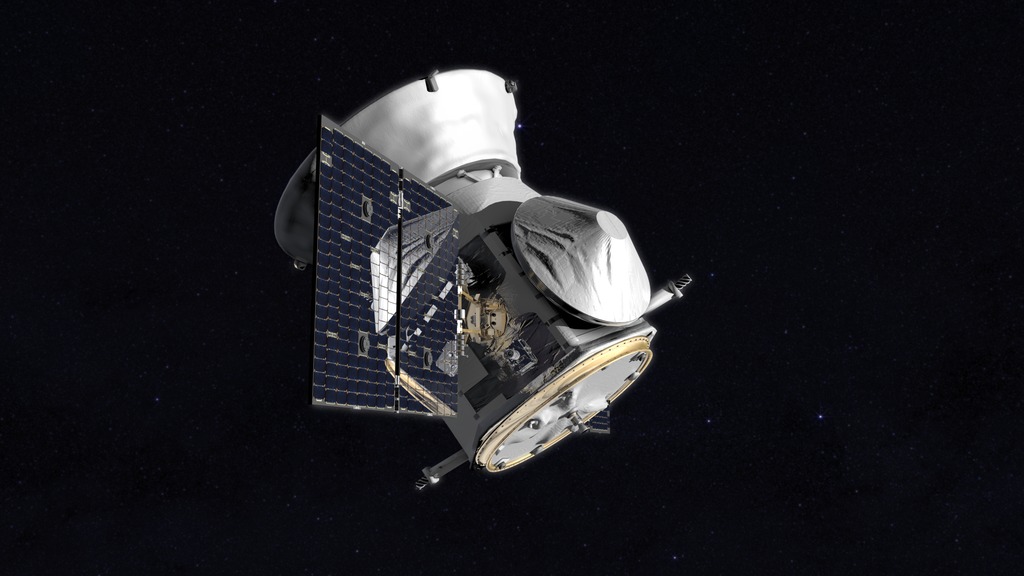
TESS’s mission overview explains the underlying method: planets are found through temporary reductions in stellar brightness. A transit survey therefore sees only systems aligned appropriately with the observer. A planet outside that alignment can remain physically present while making no detectable silhouette.
A neighboring planet is inferred
The researchers combined changes in transit timing and duration with radial-velocity measurements from the NEID instrument. Their modeling points to another nearby planet whose orbital plane is tilted relative to TOI-2535 b’s. The gravitational interaction makes the orbital planes precess, rather like the changing orientation of a spinning top.
The paper describes the perturber as probably at least Saturn’s mass and likely in a mean-motion resonance with the known planet. Those are model-based constraints on an unseen companion. They should not be read as a direct image, a precisely measured mass or a uniquely established orbital solution.
UCLA reports an estimated return to transits in roughly 30–50 years. That is a prediction based on the proposed dynamics, not an observation already in hand. Further measurements can refine both the system architecture and its future behavior.
Why this is more than a disappearing act
The system presents a useful challenge for planet-formation research. Hot Jupiters must be explained in the context of how giant planets form and arrive close to their stars. A neighboring giant capable of strongly disturbing the orbit adds another constraint to that history.
More immediately, the observations demonstrate why long baselines matter. A short survey could have cataloged an ordinary transiting planet. Repeated visits revealed that the alignment itself was temporary. The record preserves orbital evolution on a human timescale, and shows how a missing signal can become evidence when the measurements leading up to its disappearance are available.
Artist concept of TESS, which recorded TOI-2535 b’s changing transits. Credit: NASA’s Goddard Space Flight Center Conceptual Image Lab. This is not an image of the planet. Image source.
Leave a Reply