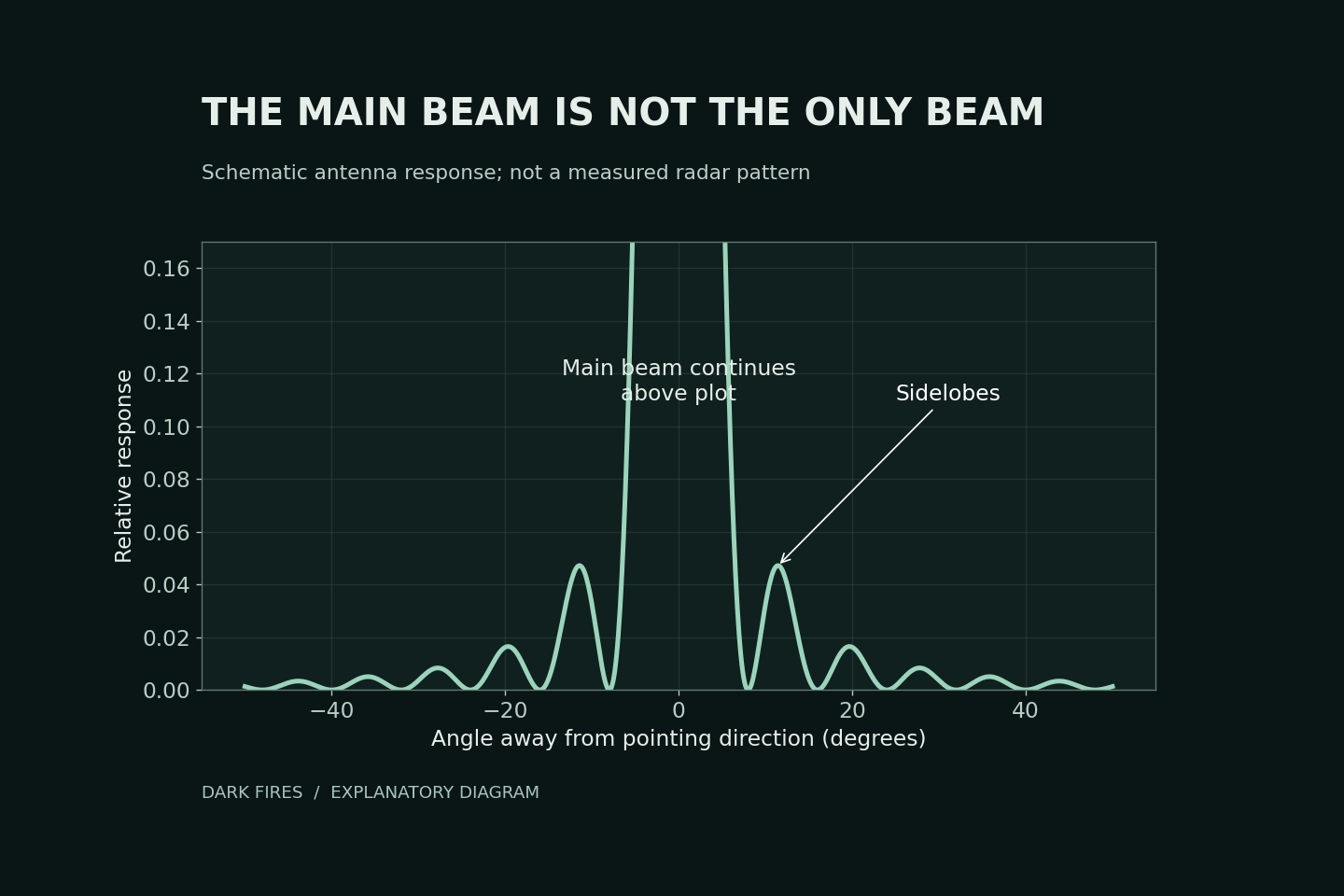
A radar echo is evidence of returned radio energy. Its displayed direction still depends on how the antenna transmits, receives and processes that energy. For an unusual UAP return, one question is whether the signal entered through the main beam or a weaker sidelobe.
Off-axis sensitivity
The National Weather Service explains that radar antennas have secondary lobes outside their strongest beam. A sufficiently strong reflector can produce a detectable return through these weaker directions, especially at short range. Treating every return as if it came from the antenna’s pointing direction can therefore misplace a reflector.
Our diagram is a schematic squared-sinc antenna pattern. The central peak extends above the plotted range so the weaker lobes are visible. It is not the measured pattern of a military radar and cannot diagnose any particular encounter.
A testable alternative, not a verdict
An investigator should request the relevant antenna pattern, scan geometry, range, signal strength and processing description. Compare the proposed off-axis reflector with the observed timing and direction. A nearby strong target is a candidate explanation only if that geometry and the instrument response support it.
Sidelobes do not make all radar tracks unreliable. Nor does naming them explain an unresolved track. The useful result is a prediction that can be checked against sensor records, rather than an assumption that either the display or the artifact explanation must be correct.
Primary source: National Weather Service antenna and beam training.
Generated illustration. Original computer-plotted schematic by Dark Fires, not a measured antenna response or UAP record.
Leave a Reply