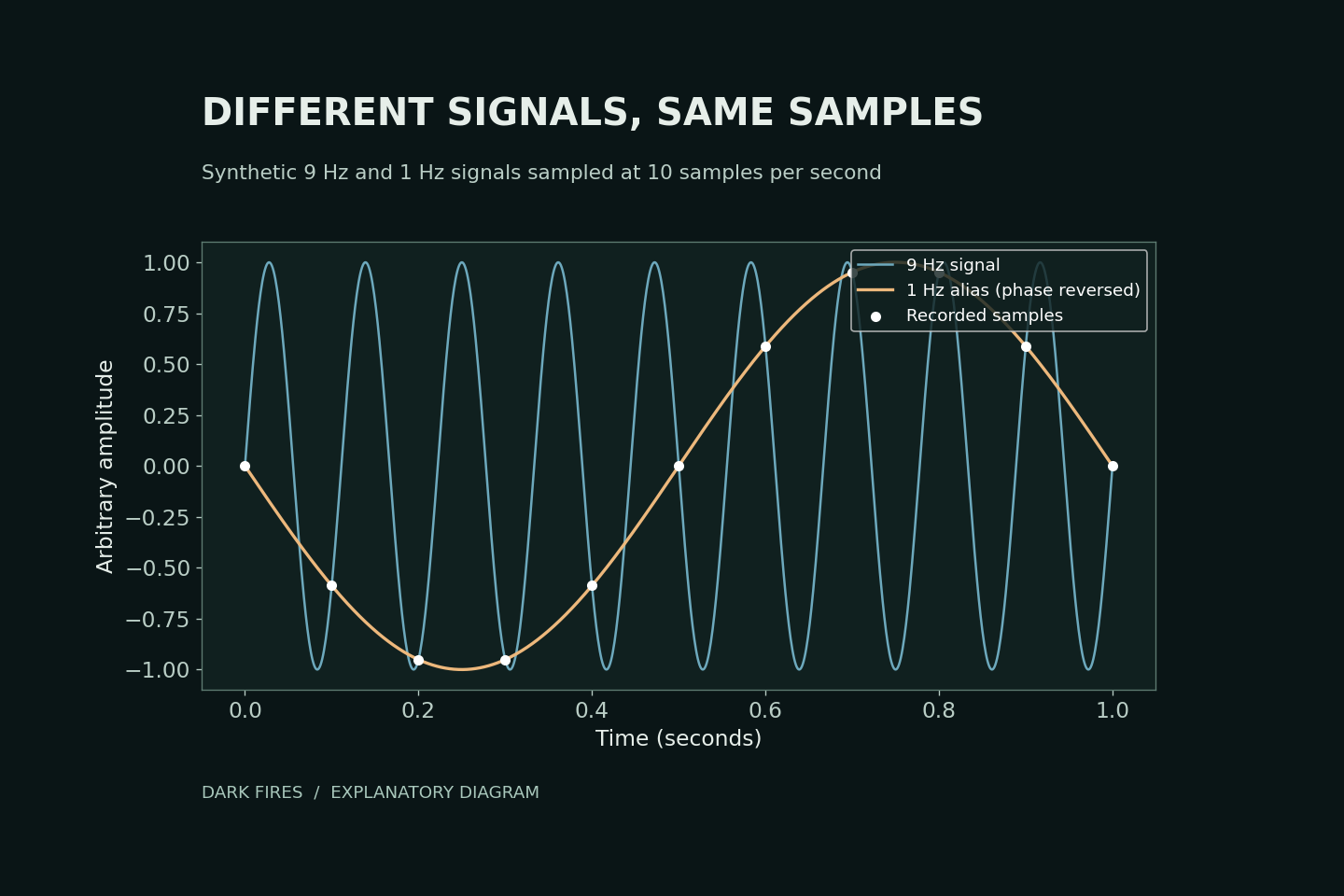
A pulsing light in a UAP video does not necessarily pulse at the rate seen during playback. A camera records a sequence of measurements, not every instant between them. Temporal aliasing occurs when different underlying changes produce indistinguishable samples.
A reproducible example
Our diagram compares sin(2π × 9t) with −sin(2π × t). At times t = 0, 0.1, 0.2 seconds and so on, both have the same value. Ten instantaneous samples per second therefore cannot distinguish these particular nine-cycle and one-cycle signals. This is synthetic mathematics, not a reconstruction of a sighting.
The Nyquist sampling condition requires a sampling rate greater than twice the highest frequency being retained. National Instruments explains why insufficient sampling can create misleading lower-frequency signals and why filtering before sampling matters.
What to preserve from a recording
Keep the original file, actual frame timestamps, exposure information and any record of frame duplication or conversion. Real camera exposures average light over an interval, so the ideal instantaneous-sample example is not a complete camera model.
Slowing playback only displays existing samples more slowly. It cannot recover the missing intervals. A second recording with a different sampling rate can help test an aliasing explanation; matching a convenient curve to one clip cannot establish the object’s identity.
Primary technical source: National Instruments on sampling and aliasing.
Generated illustration. Original computer-plotted explanatory diagram by Dark Fires; hypothetical signals, not observational data.
Leave a Reply