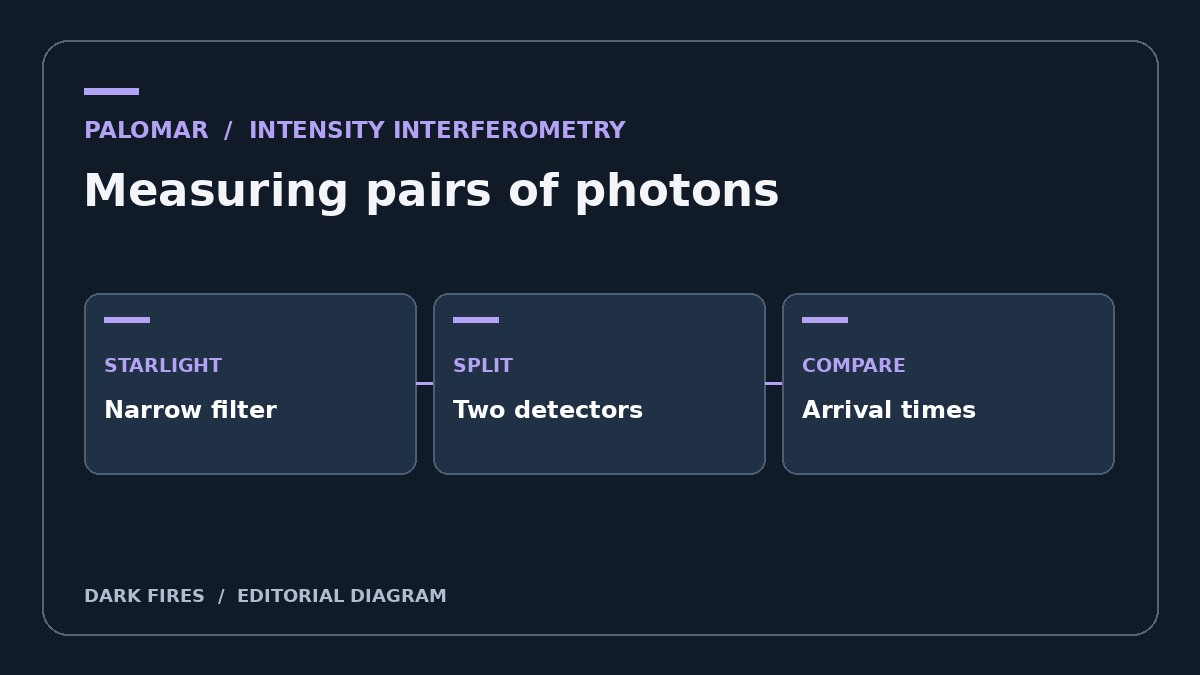
A team at Palomar’s Hale Telescope split a narrow band of Alpha Herculis’s near-infrared light between two detectors. In about seven usable hours on July 4–5 local time, the detectors recorded more near-simultaneous photon pairs than expected for independent arrivals. The result is described in a November 23 preprint.
This technique compares arrival times rather than trying to take a picture of every photon. In the team’s analysis, the zero-delay correlation was 1.3 ± 0.1, compared with 1 for uncorrelated detections. The reported coherence timescale was 0.3 ± 0.1 nanoseconds. Two other nights were too noisy for the same measurement. The authors also tested their approach on a thermal source in the lab.
The known star supplies the signal and a target for testing what the instrument can recover from starlight. The paper discusses possible future uses for looking for unusual sources of light. Those uses are proposals; the measurements here are of a known star.
Leave a Reply