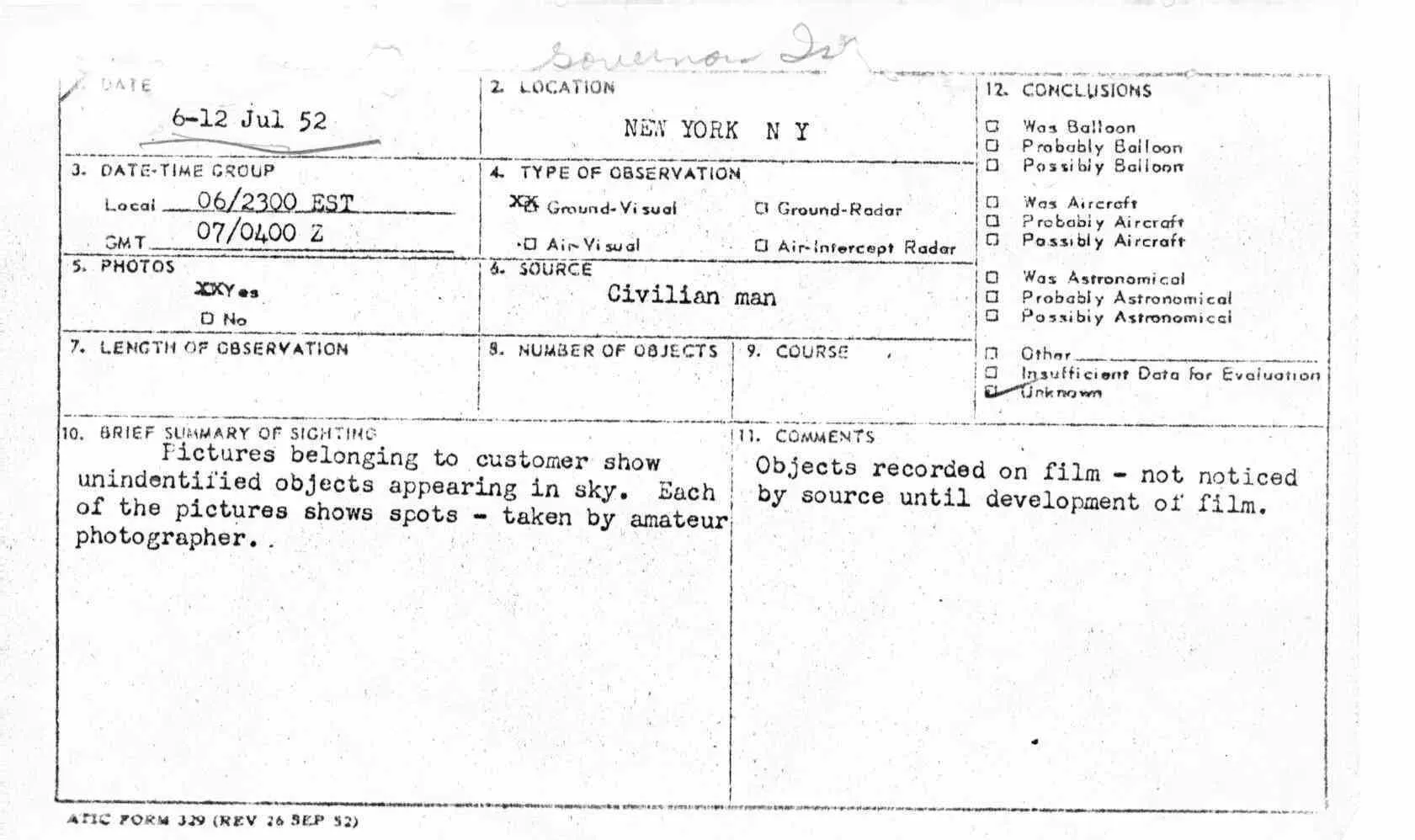
A New York City photographic case from July 1952 illustrates why an unresolved file is not automatically evidence of an extraordinary aircraft. The Air Force’s surviving summary marks the case unknown, but also records a crucial limitation: the photographer noticed the objects only after the film was developed.
The ATIC worksheet dates the photographs July 6–12. Its observation-duration, object-count and course boxes are blank. The National Archives’ 2018 review describes an amateur attempting to photograph the Moon over several nights; a commercial developer brought the unexpected lights to military attention.
The archive’s account emphasizes the thin supporting record and absence of photographic analysis. That limits what a modern reader can establish. A mark on a photograph does not, by itself, supply a measured trajectory, distance or physical size.
The checked unknown category preserves the investigators’ inability to identify the images. It does not document that every ordinary photographic explanation was tested and eliminated. This is a historical record review, not a newly reported sighting.
Source: National Archives review and reproduced case documents. Featured document: ATIC Form 329, Records of Headquarters U.S. Air Force, National Archives.
Leave a Reply