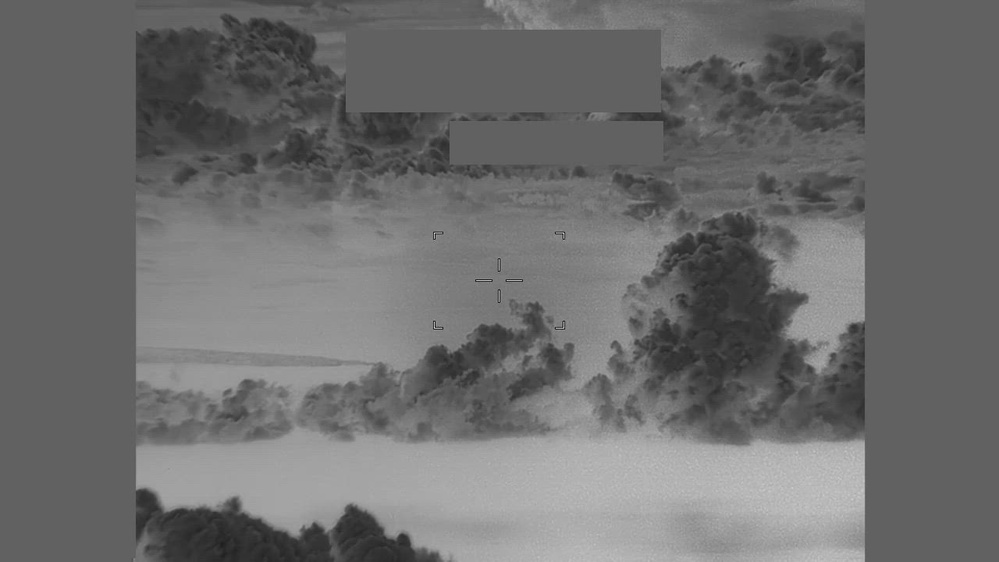
A bright point in an infrared video appears to enter Mount Etna’s plume and emerge on the other side. If the object really flew through hot volcanic gas and ash without an obvious change in its motion, that would be worth explaining. But the camera alone does not place the point and the plume at the same distance. The first question was whether they crossed paths at all.
An uncrewed U.S. Air Force aircraft recorded the footage over the Mediterranean in December 2018. In the video release, the Pentagon’s All-domain Anomaly Resolution Office says atmospheric conditions near the volcano distorted the image. The effect made the point appear to travel through the plume when the two were only aligned in the camera’s view.
AARO’s April 2025 case report also shows how different a speed estimate can look once analysts reconstruct the scene. The initial report put the object at 345 mph. AARO’s assessment was about 24 mph, consistent with an object drifting with the wind. The office put the likely balloon about 170 kilometers from the caldera. That is its estimated separation from the volcano, not its distance from the aircraft.
The balloon identification comes with moderate confidence, not certainty. Nor does this finding tell us how to identify every bright point in infrared footage. It does show why claims about what an object flew through need more than a convincing image. Mount Etna provided an unmistakable backdrop, but the backdrop turned out to be a poor guide to where the object actually was.
Featured image: Infrared footage captured over the Mediterranean in December 2018. AARO assessed that the object and Mount Etna’s plume were at different distances. Source: DVIDS/U.S. Air Force.
Leave a Reply