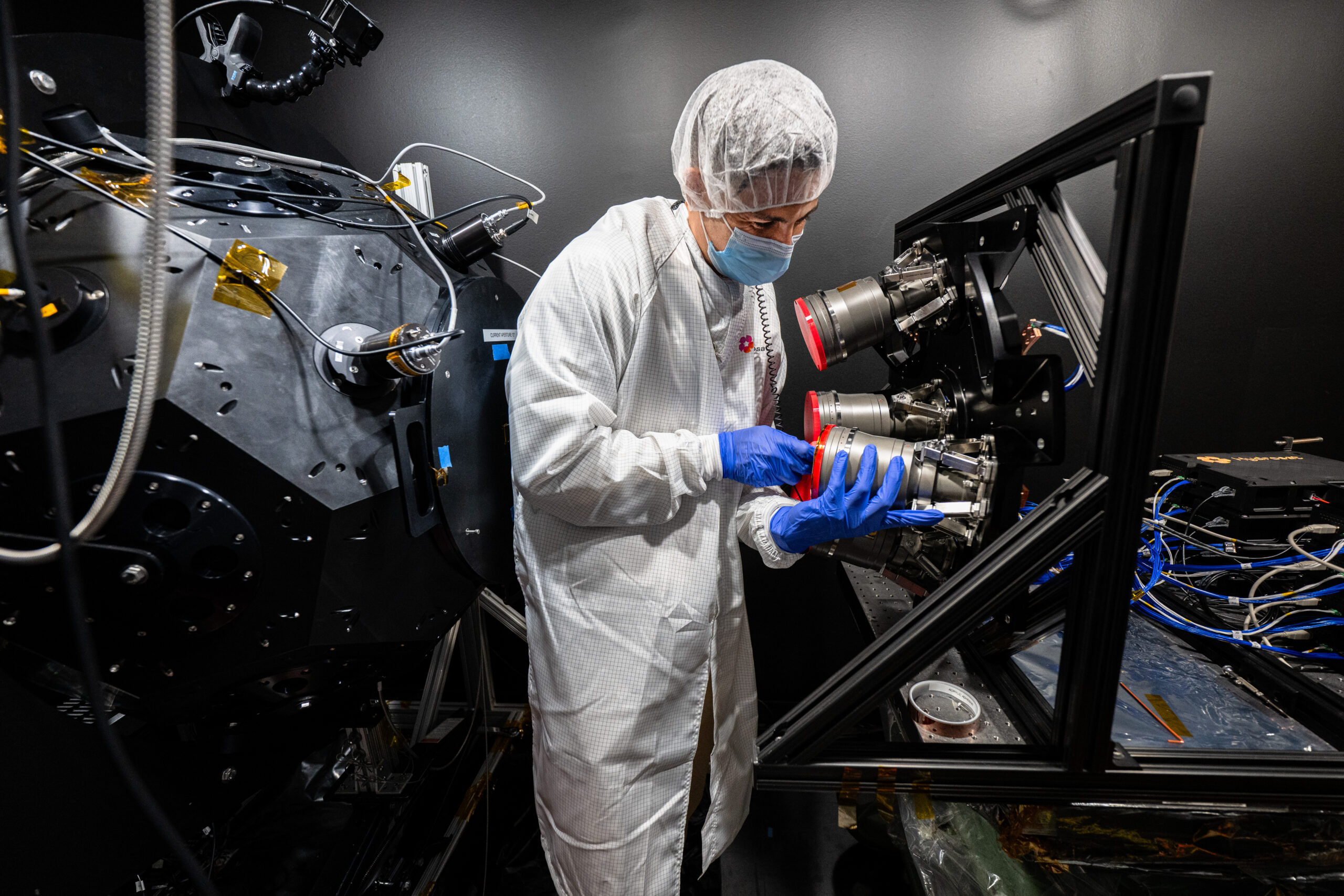
NASA announced November 18 that calibration work for Hydrosat’s four-satellite Osiris fleet was completed on October 30. The milestone concerns instruments tested on Earth, not a constellation already delivering observations from orbit.
At Goddard’s Laser for Absolute Measurement of Radiance laboratory, engineers placed eight visible-near-infrared cameras in front of an integrating sphere. Its interior spreads light uniformly, giving the sensors a controlled target rather than a patchwork of real terrain. A tunable laser supplied known wavelengths; additional tests varied brightness to check the cameras’ response.
That preparation matters because small changes in reflected light can reveal vegetation stress before a field looks obviously unhealthy. Combined with thermal measurements, those observations could help target irrigation instead of treating every part of a field alike.
The planned satellites carry visible-near-infrared and long-wave-infrared sensors. NASA says Osiris data will be available to authorized users through its Commercial Satellite Data Acquisition program. Calibration establishes a measurement baseline; useful agricultural results will still depend on subsequent observations and analysis.
Source: NASA’s November 18 report. Featured photograph: sensors prepared for testing. Credit: NASA/Desiree Stover.
Leave a Reply