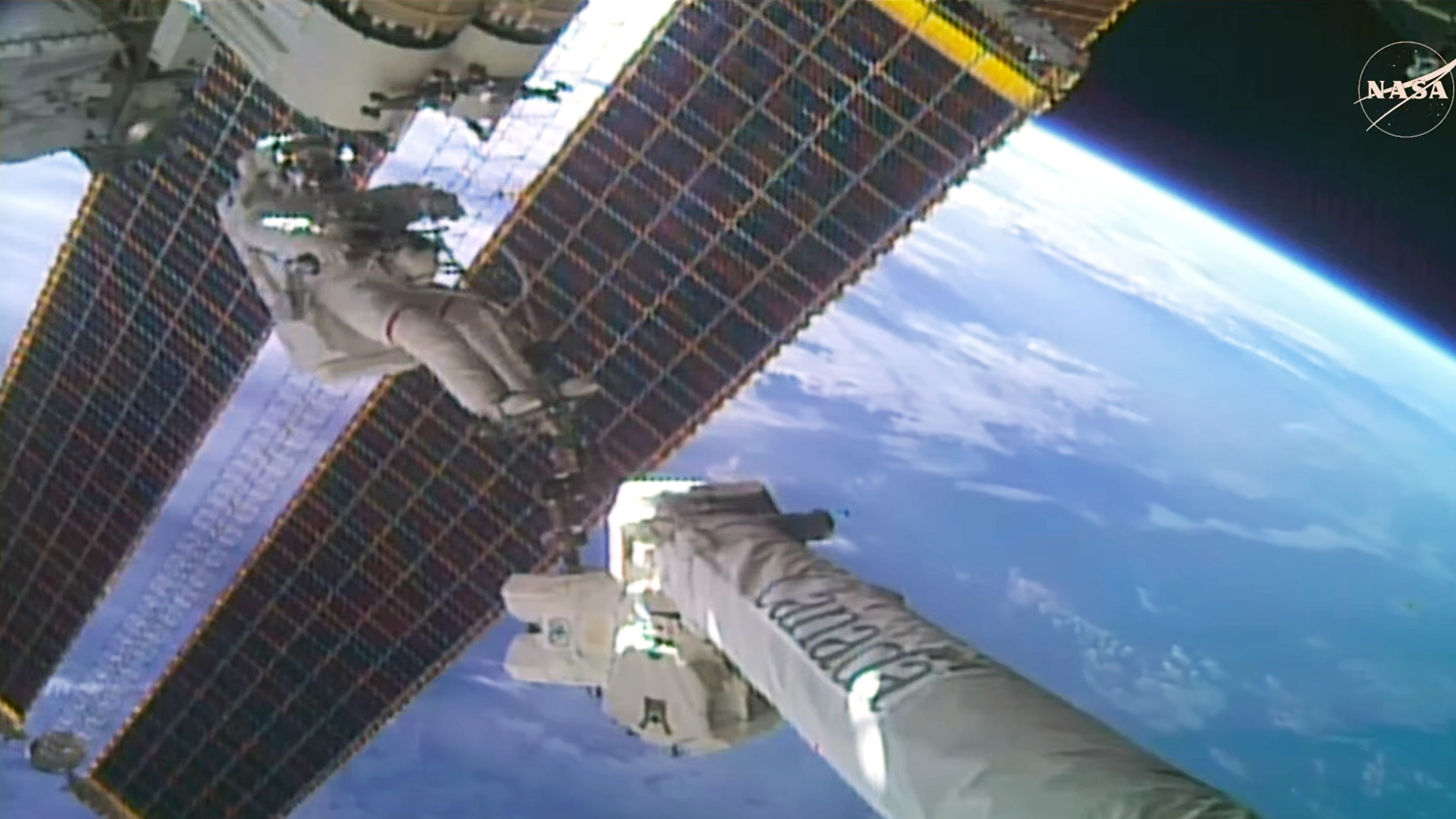
The International Space Station’s roll-out solar-array campaign reached its final installation on November 5, 2026. NASA astronaut Anil Menon and Canadian Space Agency astronaut Joshua Kutryk installed and deployed the eighth array on the station’s 3B power channel, according to NASA’s post-spacewalk report.
The astronauts finished at 3:35 p.m. Eastern Standard Time, or 2:35 p.m. in Chicago, after six hours and 59 minutes outside. NASA says the broader upgrade effort began in February 2021 and required 18 spacewalks to prepare equipment and install all eight arrays. The agency puts the resulting generation capacity at approximately 215 kilowatts, compared with 160 kilowatts before augmentation.
This was Menon’s fifth spacewalk and Kutryk’s second. It also marked the 286th excursion supporting station assembly, maintenance and upgrades, a measure of how much hands-on work the orbital laboratory has required.
A new layer of generating hardware
The approach adds compact generating surfaces rather than simply removing every older wing. NASA’s account of the first deployment in June 2021 describes arrays approximately 60 feet long and 20 feet wide, positioned to shade a little more than half of the larger original arrays.
Boeing’s 2021 explanation of the first pair says the structure supplied by Redwire allows each array to travel tightly rolled and then extend using stored energy, without a deployment motor. That packaging is central to the design’s appeal: a large collecting area must first fit inside the constraints of a launch and delivery system.
Power for the station’s remaining work
In its November 5 preview, NASA said the added electricity supports critical station operations, including a safe, controlled deorbit. That context matters when interpreting an upgrade late in a spacecraft’s working life. Reliable power remains necessary through operations and the eventual retirement sequence.
Our assessment is that the milestone illustrates the value of incremental refurbishment: astronauts have added capability to an operating facility over years of separate excursions. Completing the array campaign is a specific hardware achievement, not a declaration that all station maintenance is finished. NASA’s approximately 215-kilowatt figure describes generation capacity; it should not be read as a promise that every watt is continuously available to experiments.
The achievement is therefore best understood as added operating margin for a facility that still needs sustained care.
Featured photograph: Anil Menon rides Canadarm2 during the earlier October 29, 2026 spacewalk. Credit: NASA+. This archival image illustrates the array campaign; it does not depict the November 5 installation.
Leave a Reply