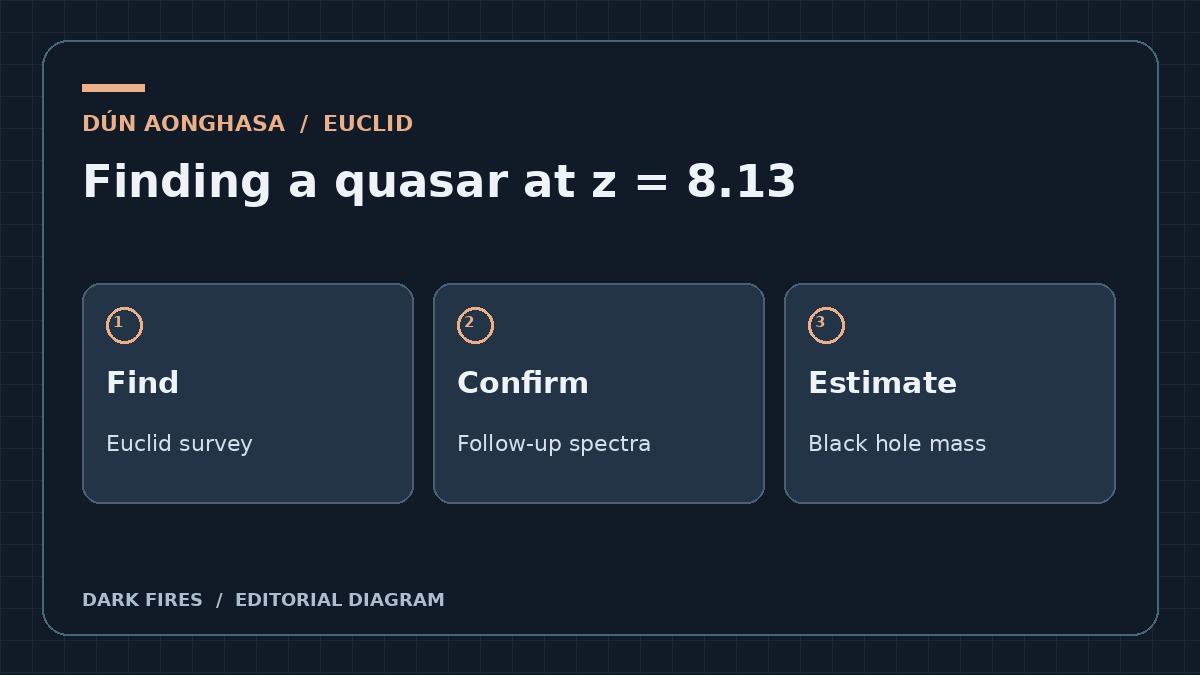
In Euclid’s survey image, J1504+6252 is a small red point. Follow-up observations from Keck, Hubble, the Large Binocular Telescope and Webb helped establish that it is a quasar, a luminous active galaxy powered by a feeding black hole. On November 24 the European Space Agency announced a measured redshift of 8.13.
That places the quasar, nicknamed Dún Aonghasa, about 630 million years after the Big Bang and pushes the quasar record roughly 40 million years earlier. It is a record for quasars, not for all objects. The Euclid Consortium’s account traces the follow-up that distinguished it from look-alikes in the survey.
Webb spectroscopy supports an estimated black hole mass of about 360 million Suns. The observed feeding rate is a snapshot at that epoch, not its lifetime average. A massive initial seed or faster growth earlier could help explain the size, but those are scenarios to test. The research paper adds an earlier constraint on growth, not a direct view of how the seed formed.
Leave a Reply