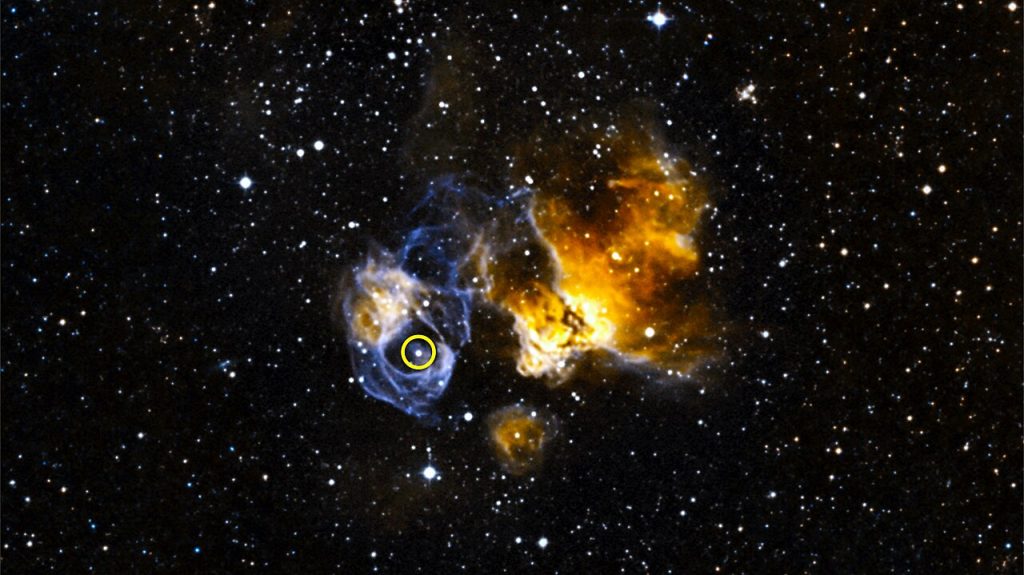
A narrow trail of molecular gas in the Large Magellanic Cloud is giving astronomers a new way to investigate one of the sky’s most powerful gamma-ray binaries. The important clue is not simply that the gas is present. It is unusually warm compared with nearby material, and its shape points back toward the binary system LMC P3.
The study was highlighted by Nagoya University on October 30, 2026. Its research preprint appeared on August 31 and was accepted for The Astrophysical Journal Letters. Those dates matter: this is a recent research result, not a newly observed explosion on November 11.
A familiar source with an uncertain engine
LMC P3 already had an unusual reputation. NASA’s 2016 discovery account described the first gamma-ray binary found beyond the Milky Way, identified through repeating changes in its high-energy output. A massive star and a compact stellar remnant orbit together, with their interactions producing radiation across several parts of the spectrum.
The remaining question is how that power is generated. One explanation involves a pulsar, a rapidly rotating neutron star whose particle wind collides with the companion’s wind. Another involves material accumulating around the compact object and feeding jets. A system operating through that second mechanism is called a microquasar.
The cooler gas records an energetic encounter
The team used ALMA to measure carbon monoxide emission around the system. The study reports a prominent, one-sided structure approximately eight parsecs long and one parsec wide, equivalent to about 26 by three light-years. A weaker candidate feature has a somewhat different orientation.
Measurements and modeling put the main structure’s gas temperature at roughly 33–60 kelvin, compared with about 15 kelvin in a nearby cloud. Although all of those temperatures are extremely cold by everyday standards, the difference is substantial for interstellar molecular gas. The authors found no radiative heating source sufficient to account for the warm feature and interpret it as gas shocked by a microquasar jet.
This distinction prevents a misleading picture. ALMA is tracing relatively cool surrounding material shaped and heated by an energetic outflow. The molecular structure is evidence of the jet’s interaction with its environment, rather than a close-up photograph of the central engine itself.
What the result establishes
The alignment, temperature contrast and comparison with simulations together strengthen the accretion-and-jet explanation. They also suggest that submillimeter observations could help identify other microquasars through the marks they leave in nearby clouds.
The compact object’s identity remains a separate issue. Nagoya’s account discusses why the high power favors a black-hole interpretation, but it still allows a neutron star. The evidence supports a physical mechanism more directly than it settles that classification.
That makes LMC P3 a useful example of astronomical inference across wavelengths: gamma rays reveal an exceptionally energetic source, while much lower-energy radio emission supplies a record of what its surroundings have experienced. The strongest conclusion comes from connecting those measurements without treating either one as a complete answer.
LMC P3 is marked within the DEM L241 supernova remnant. Credit: Chandra X-ray Observatory Center/NASA’s Goddard Space Flight Center. Public domain. Image source.
Leave a Reply