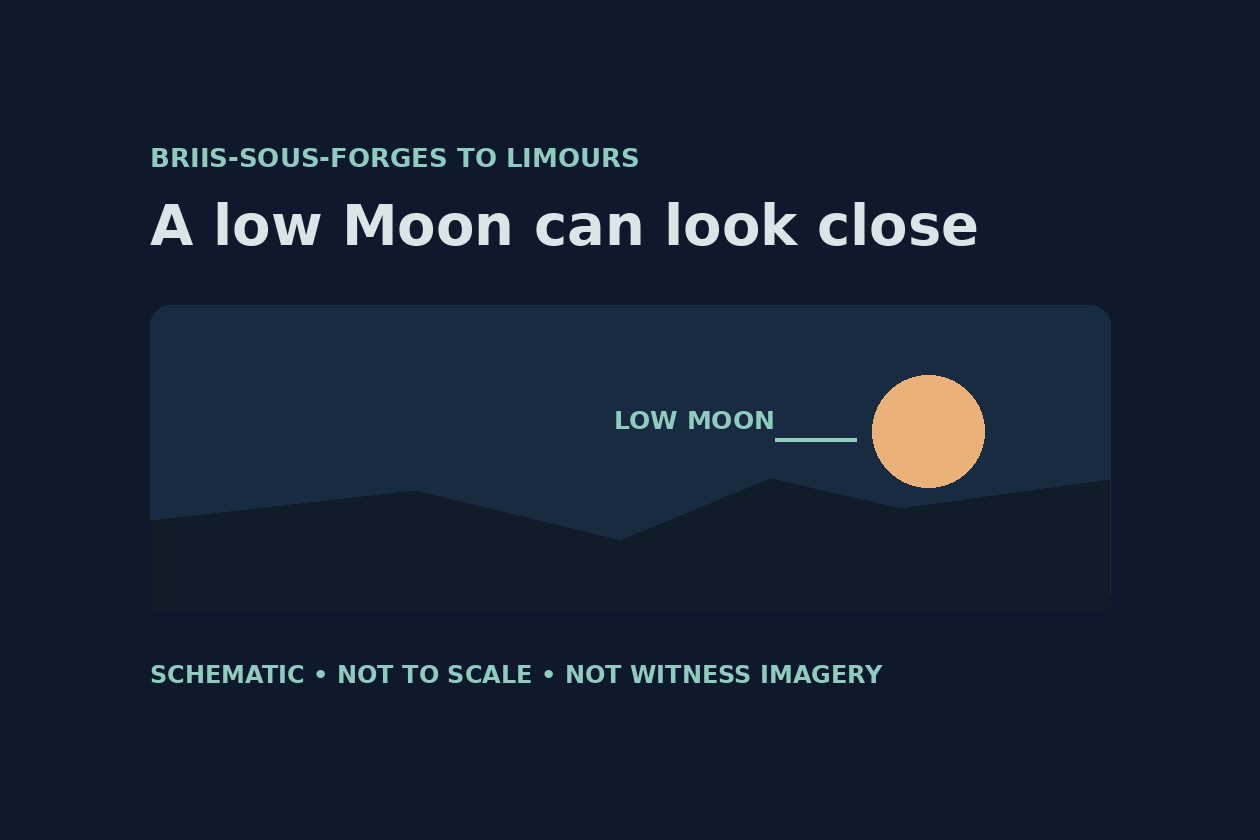
Before dawn on January 1, 2026, a driver traveling from Briis-sous-Forges toward Limours, in France’s Essonne department, saw a yellow-orange circle low ahead of the car. According to the GEIPAN case summary, it looked diffuse rather than dazzling, with a slightly irregular edge. The driver had the impression that it moved with the vehicle before dropping out of sight. The observation lasted less than a minute, between about 6:35 and 6:40 a.m.
There was no usable recording and only one witness statement. What investigators did have was a questionnaire, sketches and a reconstruction of the route. Those materials let them compare the witness’s estimated direction and elevation with the sky at the reported time. GEIPAN found that the Moon was very low at an azimuth of about 309 degrees, or northwest, in close agreement with the reconstructed line of sight. The geometry mattered more than the color: a yellow-orange appearance fits the explanation, but color alone would do little to distinguish one possible source from another.
GEIPAN also found clouds in that direction. A Moon already close to the horizon can disappear behind cloud progressively without moving quickly through space. Likewise, objects close to a car sweep past rapidly as the driver moves, but a very distant object changes bearing much more slowly. A nearly constant bearing can feel like company, even though the object is not keeping pace with the car. Neither effect requires the witness to have imagined the light; it changes what can be inferred from the motion the driver perceived.
The archived case, updated April 28, 2026, is class A: GEIPAN identified the light as the setting Moon. That conclusion rests on the fit between an estimated viewing direction and a calculable lunar position, not a video that independently measured its path. The surviving drawings help locate a sight line. They should not be read as photographs of the Moon or as a precise record of every moment of the sighting.
Primary source: GEIPAN case file and accompanying documents. Generated illustration: editorial schematic, not witness imagery and not to scale.
Leave a Reply