Technical guide · Sources checked November 5, 2026, Chicago time.
Two recordings of the same light can be much more informative than one. But two viewpoints are not, by themselves, a distance measurement. A useful reconstruction needs known camera geometry, matching observations and uncertainty small enough to distinguish a finite range.
The small difference that carries the distance
MathWorks’ stereo-reconstruction documentation explains the basic relationship for a calibrated, rectified stereo pair: depth equals focal length multiplied by camera separation, divided by disparity. Disparity is the offset between corresponding image positions. More distant objects produce smaller offsets.
This has an important consequence: when the offset becomes comparable to measurement error, the inferred distance becomes unstable. A precise-looking output is not necessarily a precise result.
Consider an illustrative calculation, not a real sighting. With a 10-meter baseline and a focal length of 1,000 pixels, a disparity of two pixels gives a depth of 5,000 meters in that simplified model. If the true disparity could instead be one or three pixels, the corresponding depths are 10,000 and about 3,333 meters. A one-pixel uncertainty has produced a very wide distance range.
Camera separation is only part of calibration
Knowing where two people stood is helpful, but camera orientation and optical properties also matter. MathWorks’ baseline-estimation documentation explicitly estimates translation and orientation between cameras, using independently established camera intrinsics for its wide-baseline workflow. It also exposes estimation errors rather than treating calibration as exact.
The practical implication is that two phone clips should not be inserted directly into the simplified formula merely because the witnesses were a known distance apart. Different lenses, framing and viewing directions must first be accounted for.
What to request from a reconstruction
Our suggested review checklist starts with the original files, camera locations, recording settings and a stated synchronization method. For a moving target, matched frames must refer to the same moment; otherwise motion can masquerade as a difference between viewpoints.
Ask the analyst to show the matched feature in both images, explain the calibration and provide a range of results under plausible errors. Test whether the conclusion survives slightly different feature selections rather than depending on a single hand-picked pixel.
Finally, separate depth from total camera-to-target distance when the geometry requires it. If the observations cannot constrain a useful range, report that limitation. Two cameras may confirm that multiple observers recorded an event while still leaving its distance unresolved. That is valuable evidence, but it is not permission to assign an exact size or speed.
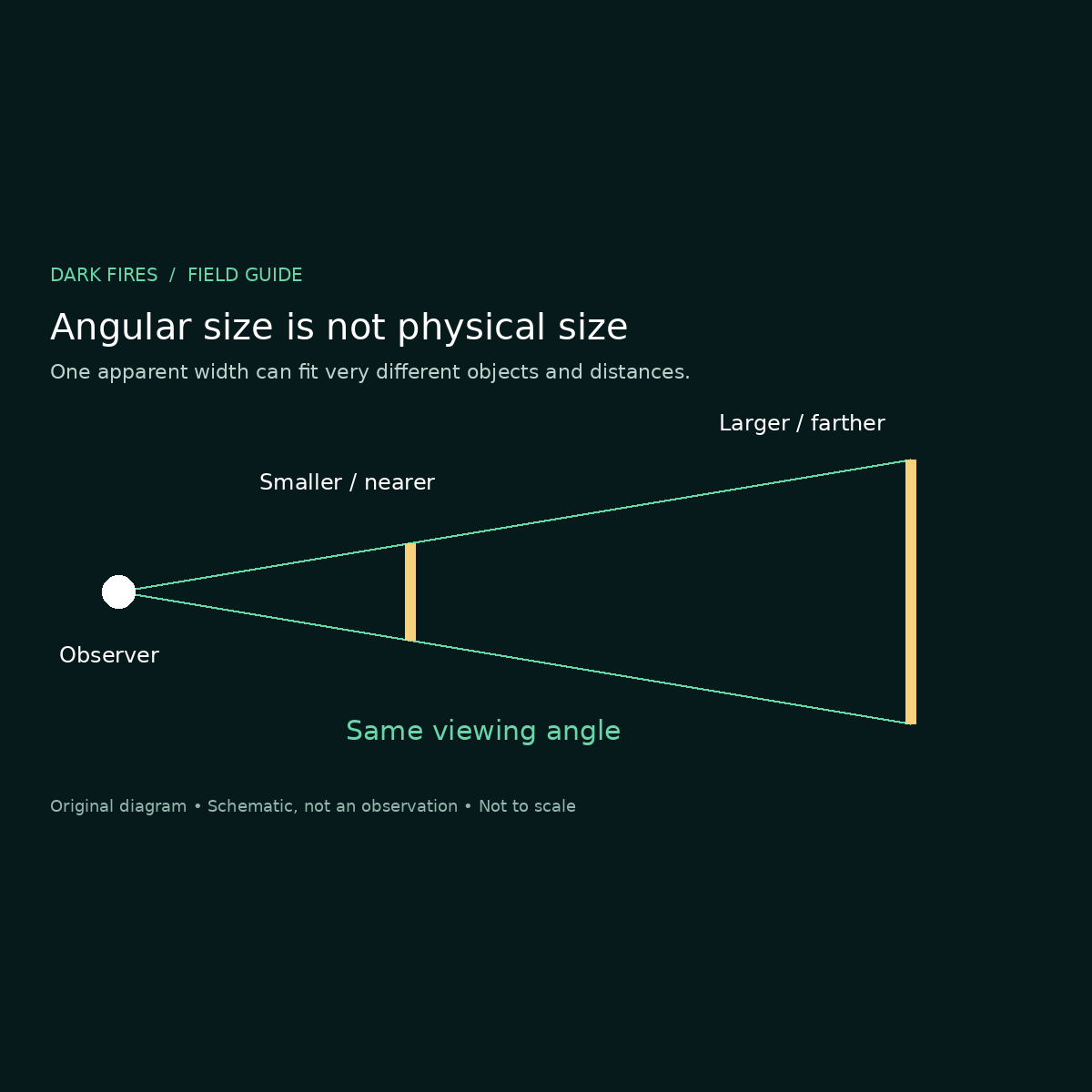
Featured diagram: Dark Fires original illustration of the size-distance ambiguity in one view. Context for why range matters, not a stereo-camera layout; not to scale.
Leave a Reply