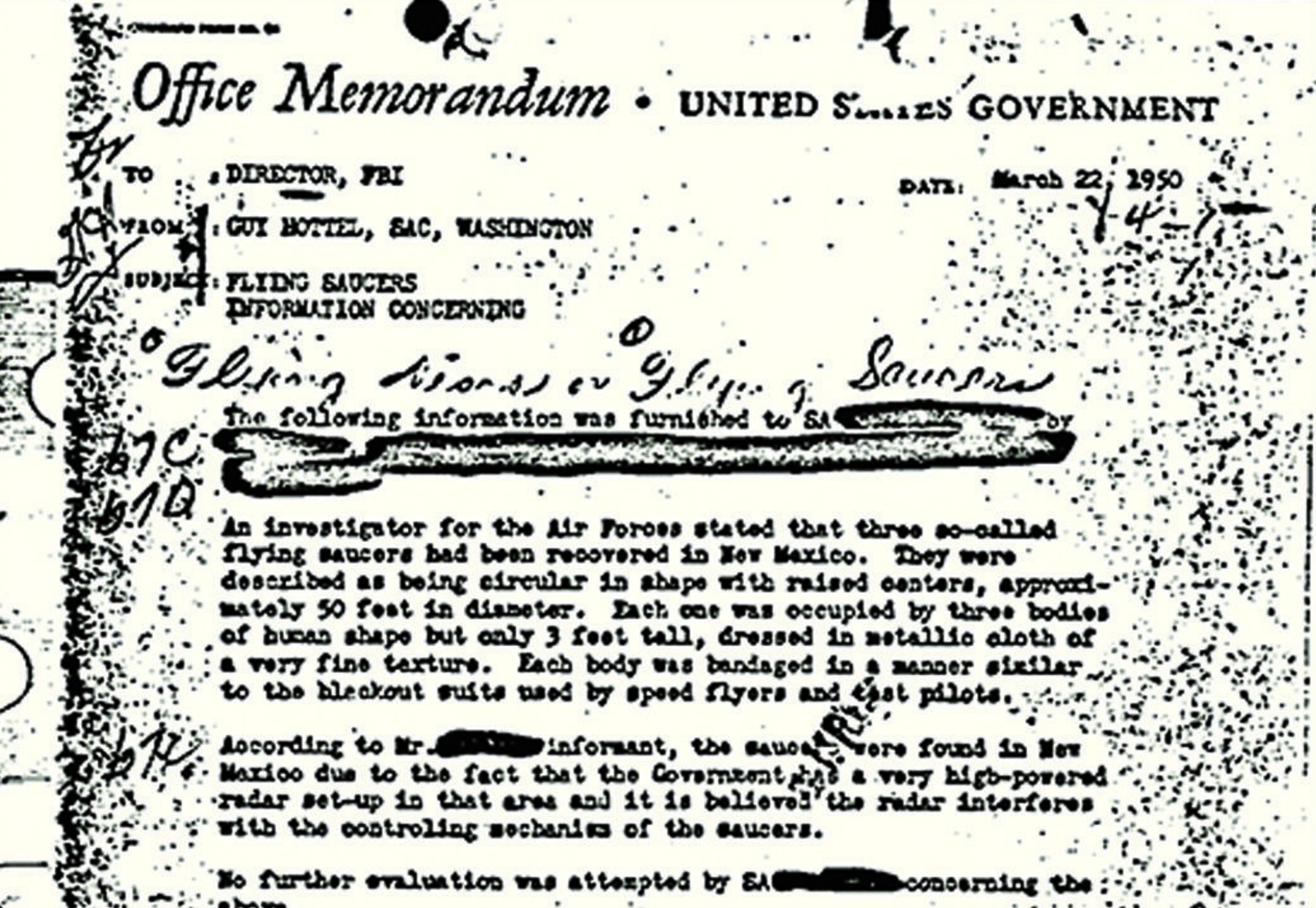
A government document can be authentic while the story it records remains unverified. The March 22, 1950 memorandum associated with FBI official Guy Hottel is a particularly clear example. Its historical importance lies partly in the extraordinary claim it preserves, and partly in how easily a filed report can be mistaken for an official finding.
The FBI’s March 25, 2013 explanation identifies Hottel as the head of its Washington field office. His memo relayed a story passed through another person concerning an Air Force investigator and alleged recovered saucers in New Mexico. The account included small human-shaped occupants and a suggested connection to powerful radar. The FBI says it did not investigate the claim.
What the document actually records
The Bureau provides an image of the historical memorandum, allowing readers to examine the record rather than relying on a modern headline. Its existence establishes that the allegation entered FBI files. Establishing the alleged recovery would require additional evidence, such as identifiable recovery records, examination reports, or independently corroborated testimony.

The FBI also cautions against presenting the memo as a new Roswell disclosure. It dates from nearly three years after the July 1947 Roswell events and was publicly released in the late 1970s. The Bureau’s 2013 account says attention surged after its online Vault launched in 2011. A change in how easily a document can be found is different from a newly documented event.
The Bureau’s role was changing
An earlier FBI historical account, published April 6, 2010, describes the institutional background. In July 1947, the Bureau agreed to assist Army Air Forces Intelligence with flying-disc investigations. By July 1950, its policy was to forward such information to the Air Force rather than investigate or evaluate it itself. That history helps explain why UFO-related material appears in FBI holdings without every item representing a completed Bureau inquiry.
Reading the memo carefully means following the chain of attribution. Who wrote the document? Who supplied the story? Who supposedly observed the underlying event? Each transfer creates a separate question about access, accuracy, and corroboration. An official recipient does not remove those questions merely by recording the information.
The same discipline applies to a proposed debunking. The FBI’s explanation says its files do not verify the theory that this memo repeated a contemporary hoax. That leaves a narrower, defensible conclusion: the document records an uninvestigated allegation. It should not be promoted into proof of recovered alien bodies, or used to claim that the Bureau established a particular hoax explanation.
For historical UAP research, the Hottel memo remains a useful lesson in reading administrative records. Preserve the document’s date, identify its information sources, and keep its evidential limits attached whenever the claim is repeated.
Featured image: excerpt of the March 22, 1950 Guy Hottel memorandum. Credit: Federal Bureau of Investigation, public-domain federal record. FBI image source.
Leave a Reply