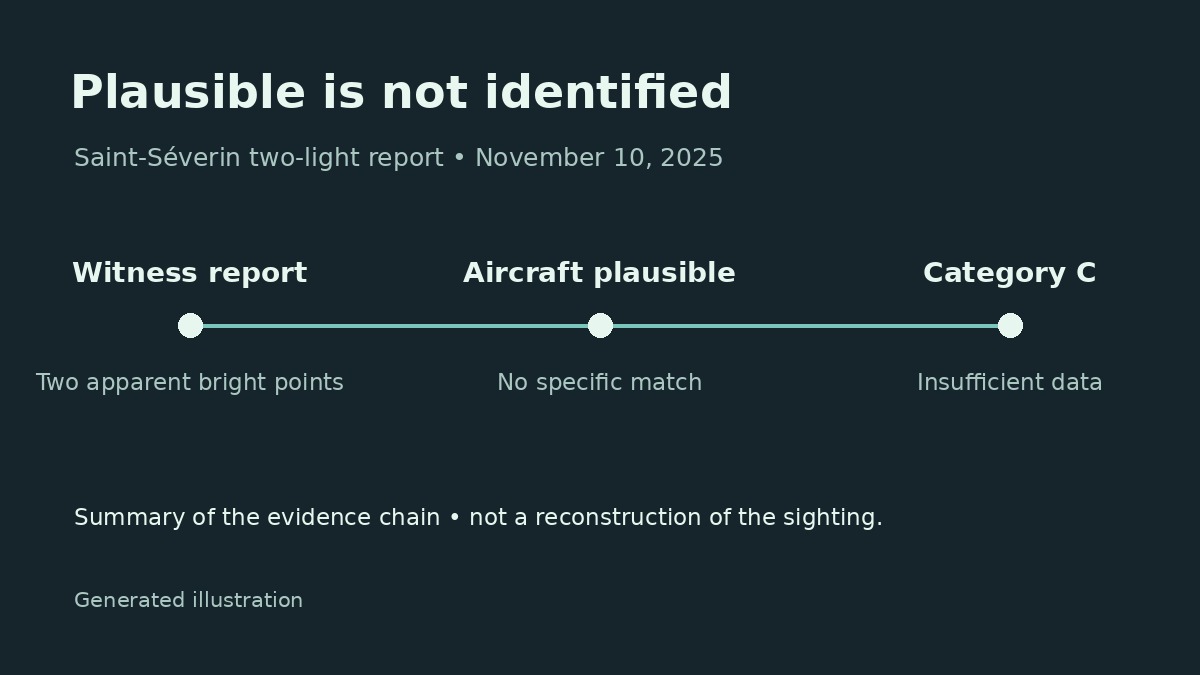
A witness near Saint-Séverin, France reported two bright lights that appeared nearly still on November 10, 2025. GEIPAN checked astronomical and satellite explanations but found no support in the available orbits for two bright satellites appearing almost stationary over the reported three minutes.
Investigators considered forward-facing aircraft lamps. The radar candidates they evaluated would have appeared roughly 2 to 3.2 degrees above the horizon, well below the witness’s revised estimate of about 45 degrees. That mismatch kept these tracks from identifying the lights; it did not establish the lights’ observed altitude or exclude every aircraft.
Without images or a reliable reference point, GEIPAN could not firmly place the lights. Its Category C finding means there was too little information to identify them. The same missing evidence also limits what can be said about their performance.
Sources: GEIPAN investigation; classification definitions.
Featured image: Generated illustration.
Leave a Reply