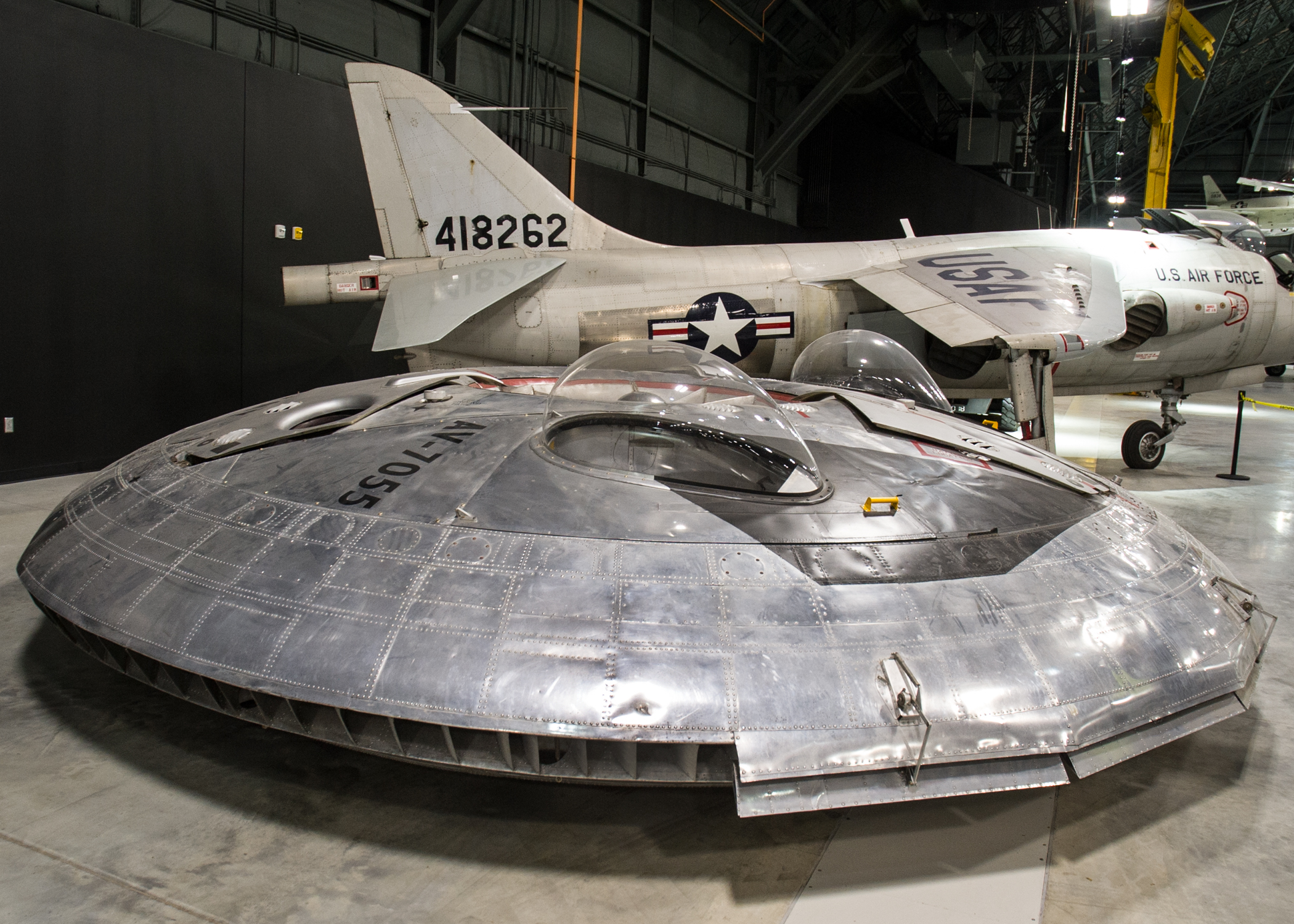
The United States military really did test a disc-shaped aircraft. That fact is more useful when paired with the less spectacular record of what the Avrocar could do: hover close to the ground, struggle with stability, and fall far short of its designers’ ambitions.
The National Archives’ account of the project describes a proposed vertical-takeoff aircraft that was initially supposed to reach Mach 4. The thinking was practical as well as ambitious. Conventional runways were vulnerable to attack, so an aircraft that could rise vertically might operate from less exposed facilities.
A test program, not a finished capability
Avro Canada’s VZ-9AV used a circular airframe and a central fan system. Surviving motion pictures document construction, changes to the controls, and flight tests from February 1958 through June 1961. They are especially valuable because they show development as a sequence of problems and attempted fixes, rather than presenting an isolated photograph of an unusual machine.
According to the Archives’ summary, modifications improved stability, but the vehicle remained limited to a hover of about three feet and speeds no greater than 35 miles per hour. Dust and debris drawn into the air intake restricted operating time. The final film includes a terrain course intended to test whether the aircraft could serve as a low-flying transport.
Those results were a long way from a supersonic aircraft. The Pentagon ended the program in late 1961. A prototype’s unusual outline therefore should not be confused with evidence that its advertised performance was ever achieved.
What the archive establishes
The Archives’ UAP moving-image guide lists the Avrocar progress and development films alongside other historical records. Their inclusion is a way to locate relevant material, not an official finding that any particular unexplained sighting was an Avrocar.
The release chronology also matters. The Archives says some related schematic and report records were declassified in fall 2012, while the films had been available for longer. A later release date is not the date of a new test or a newly discovered working vehicle.
Avrocar is a useful corrective in both directions. A flying-saucer shape was not confined to fiction, but neither did building one confer extraordinary flight performance. Connecting it to a reported sighting would still require matching dates, locations, documented operations and observed behavior. The hardware record supplies context; it does not supply those missing links.
Featured image: Ken LaRock/U.S. Air Force, via Wikimedia Commons, licensed CC BY-SA 4.0. Museum photograph taken May 11, 2016; not a flight-test image.

Leave a Reply