Two researchers can agree that they possess exactly the same UFO video while still disagreeing about what it shows. A cryptographic hash helps establish the first point. It cannot settle the second.
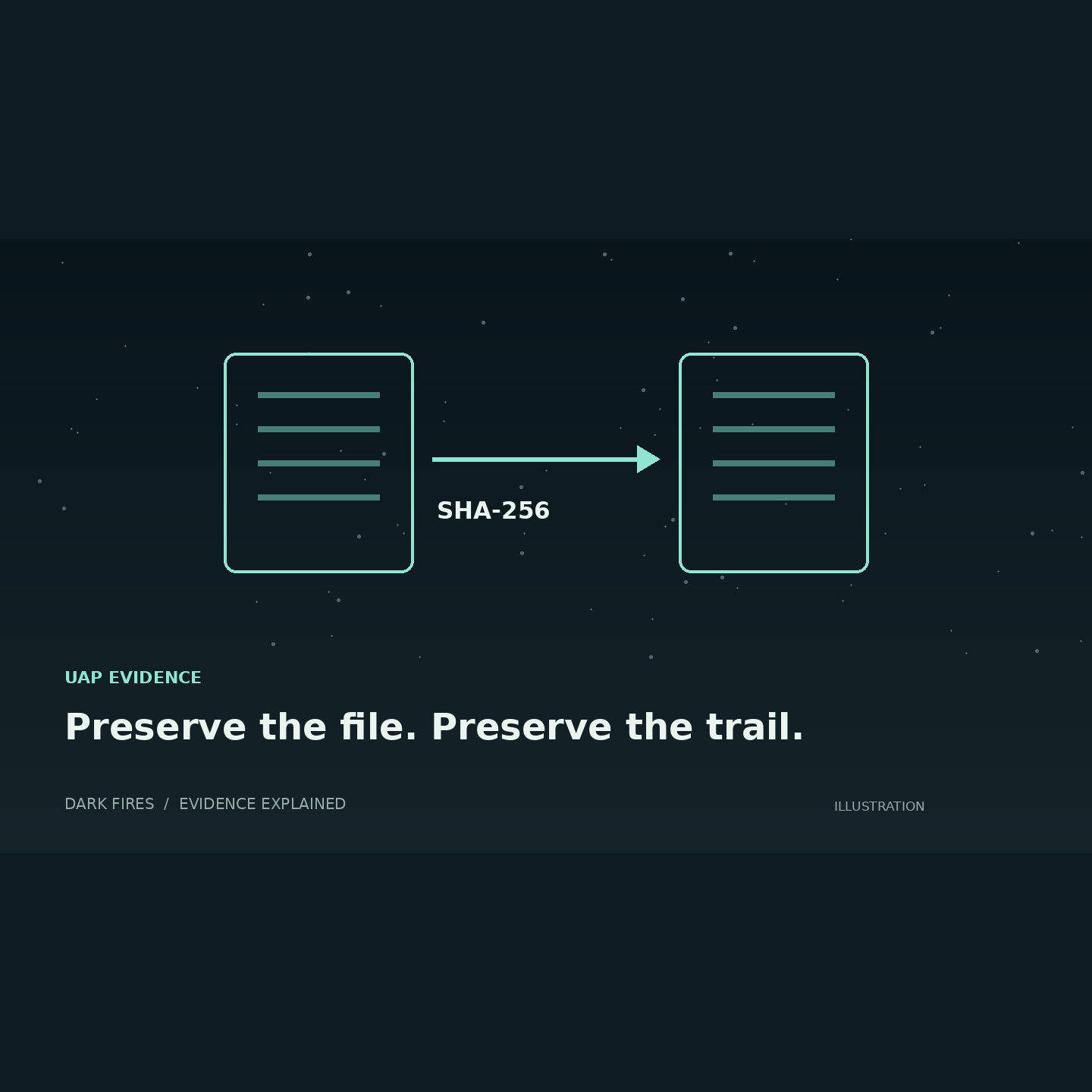
A hash is a value calculated from a file’s data. Used with an appropriate secure algorithm, it provides a practical way to check whether a later copy matches the version that was recorded and hashed earlier. This is valuable for UAP research, where clips may pass through witnesses, investigators, editors and social-media accounts before reaching an analyst.
Integrity starts at a particular moment
NIST’s September 2022 digital-evidence preservation report recommends documenting a file’s source and transfers, calculating secure hashes, and protecting the stored hash information. It also identifies an important weakness: evidence can be altered before its first hash is made.
Suppose an investigator downloads a clip on Monday and calculates its hash. An identical hash on Friday supports the conclusion that the file has not changed between those checks. It says nothing by itself about what happened before Monday. The clip might be a camera original, an edited export, a staged scene or a copy of something posted years earlier.
The Scientific Working Group on Digital Evidence’s image-authentication guidance, version 1.0 dated July 11, 2018, explicitly separates file integrity from the truth of the depicted scene. That distinction prevents a technical check from becoming an unsupported claim of authenticity.
Preserve a trail, not just a checksum
For a civilian UAP collection, a useful record can be straightforward: identify who supplied the file, when it was received, its original filename, how it was transferred and which version was hashed. Keep the received file unchanged. Work on a separate copy, and label every crop, brightness adjustment, stabilization or annotated export.
SWGDE’s Digital Forensic Video Analysis guidance, version 2.0, calls for documented processing that can be reproduced. It warns that even changing a video’s container while preserving the video stream can affect metadata. A different file hash after conversion therefore needs explanation, not an immediate accusation of deception.
Separate two kinds of questions in the case notes. “Are these files identical?” concerns bytes and transfers. “Was this recorded where and when the witness says?” requires other support. A believable account, a plausible timestamp and a clean-looking image do not make those questions interchangeable.
Privacy also matters. A preservation copy may contain location details or bystander information that should not be published. Retain the original securely and clearly identify any public redacted derivative. Do not erase the distinction merely to make the public package simpler.
A matching hash is a modest but powerful promise: this is the same file that was previously checked. Keeping that promise narrow makes the evidence stronger. Expanding it into proof of an extraordinary event makes it weaker.
Featured image: Generated illustration. Original Dark Fires file-integrity diagram.
Leave a Reply