A bright object crosses the sky, but the witness hears nothing. That detail deserves to be recorded accurately. It cannot, by itself, establish that the object produces no sound or uses an unfamiliar propulsion system. Before interpreting silence, ask what sound could have reached that observer during the available listening window.
Light and sound report different moments
For ordinary terrestrial distances, light reaches a witness effectively immediately. Sound takes much longer. OpenStax’s treatment of sound speed gives about 343 metres per second in air at 20°C. Temperature changes that value, so it is an approximation rather than a universal atmospheric constant.
Consider an illustrative source 3.43 kilometres away. Dividing distance by 343 gives a ten-second sound delay. At 10 kilometres, the same simplified calculation gives about 29 seconds. A clip ending five seconds after a distant flash does not cover either arrival time. These are example distances, not estimates for an unidentified object.
Motion adds a further complication. Sound arriving now was emitted at an earlier position. If a source travels sideways at 200 metres per second during a ten-second interval, its position changes by two kilometres. That arithmetic does not calculate the complete sound path, but it shows why looking toward the current light and expecting its engine noise from exactly there can mislead.
Distance reduces what reaches the microphone
In an ideal free field, with spherical spreading and no absorption, doubling the distance spreads the same acoustic power over four times the area. The intensity falls to a quarter, corresponding to about six decibels. OpenStax explains this inverse-square model. Real aircraft are directional sources in a changing atmosphere, so the simple rule is a starting point rather than a complete prediction.
A practical comparison needs background sound too. Traffic, wind at the microphone, nearby speech or machinery can conceal a distant signal. A quiet-looking video may have no audio track, edited audio, or recording settings that do not preserve faint ambient sounds. Ask for the original file and a description of the recording setup before treating the soundtrack as a calibrated measurement.
Build a useful listening record
For a future sighting, keep recording after the light disappears, if doing so is safe. Note whether you were outside, behind glass, wearing headphones or inside a moving vehicle. Write down nearby noise sources and whether any sound appeared later. Preserve the original soundtrack even when it seems uninteresting.
For an existing report, separate three statements: the witness did not notice a sound; the recording contains no recognizable sound; and a suitable instrument measured an upper limit on sound level. These statements have different evidential strength. Only the third begins to support a quantitative comparison, and it still requires the instrument’s frequency response, noise floor and geometry.
Atmospheric conditions also matter. NOAA’s explanation of thunder propagation describes how temperature structure changes the paths of sound. A weather observation at ground level alone cannot reconstruct every layer between a distant source and a listener.
What silence can establish
A well-documented absence of an expected sound can help test a specific aircraft hypothesis when distance, operating conditions, propagation and detection limits are constrained. Without those inputs, the responsible conclusion is narrower: no sound was detected under the reported conditions. Keep that observation in the case file without turning it into a measurement of propulsion.
Sources and further reading
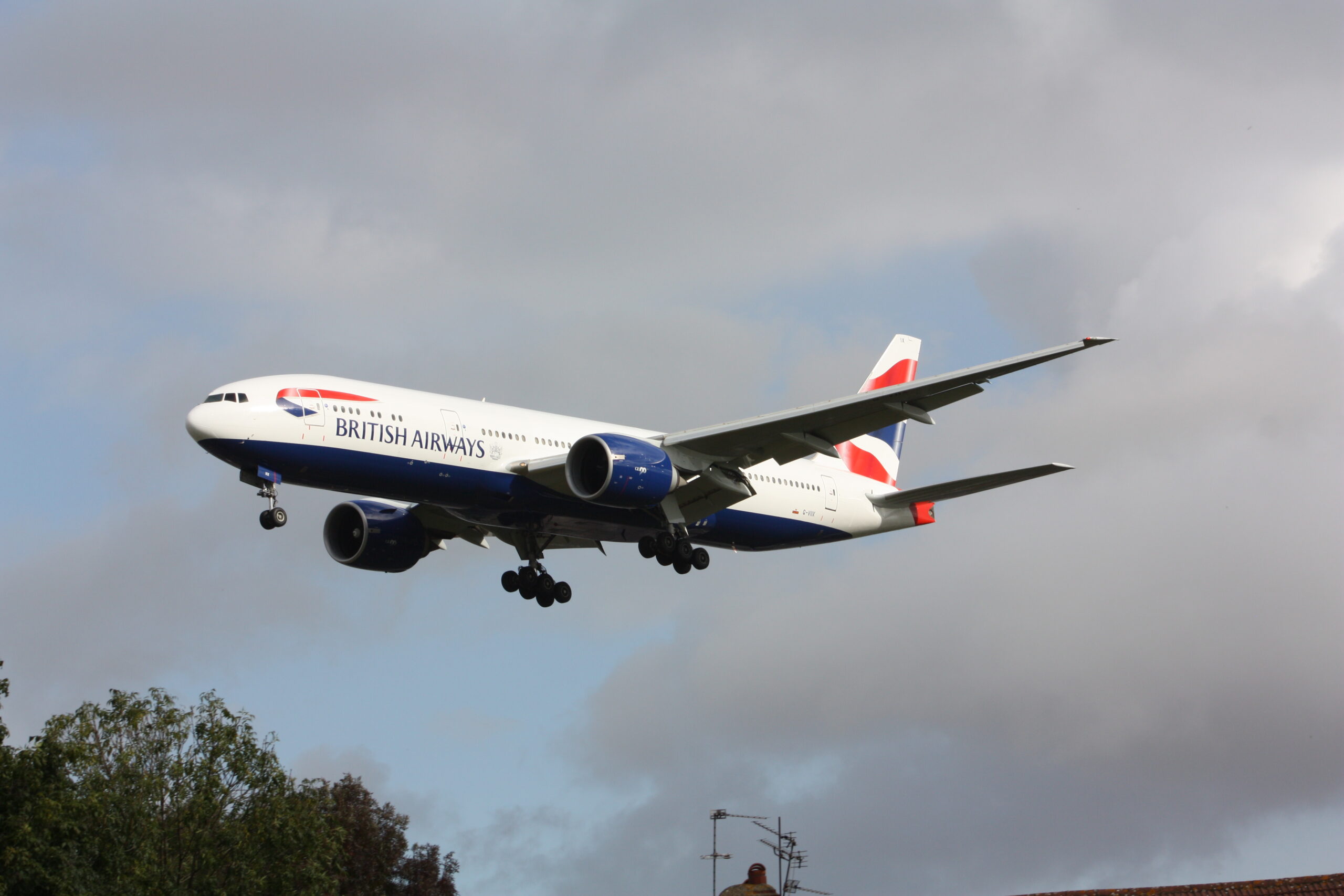
Featured photograph: Boeing 777 approaching London Heathrow, 17 October 2014. Credit: MercerMJ / Wikimedia Commons, CC BY-SA 2.0. Contextual aircraft photograph; not a UAP sighting. WordPress display sizing/cropping.

Leave a Reply