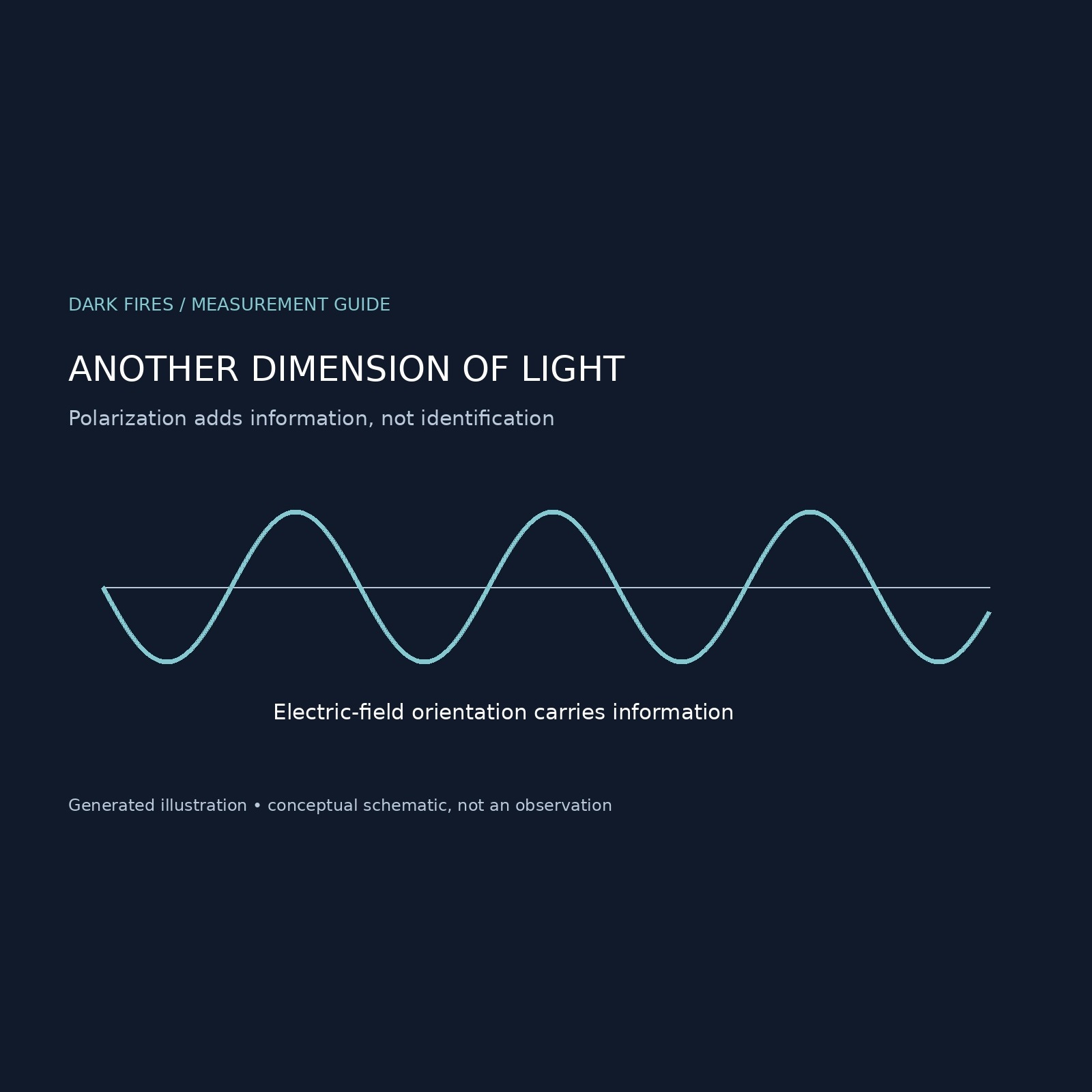
Brightness and color are not the only measurable properties of light. Polarization describes the orientation behavior of its electric field and can preserve information about the light’s source and interactions along the way.
NIST’s optical-polarization program explains that ordinary intensity measurements often discard this information. Polarimetric measurements can help distinguish scattering mechanisms, including contributions from rough surfaces, particles and a material’s interior.
But polarization is not inherently exotic. NASA’s atmospheric-science teaching material explains that sunlight becomes partly polarized through Rayleigh scattering by air molecules. The viewing geometry affects that polarization. Even a clear sky supplies a strong ordinary example.
For UAP observation, the useful question is consequently not whether polarized light exists, but whether measured polarization helps discriminate competing explanations. This is an application of established optics, not a claim that NIST or NASA has identified a specific UAP with it.
Useful comparisons require the wavelength, viewing geometry, instrument response and measurement uncertainty. An unexplained polarization reading without those controls remains an incomplete measurement, not a signature of advanced technology.
Primary sources: NIST optical polarization metrology; NASA Rayleigh scattering teaching material.
Featured image: Generated illustration. Conceptual schematic, not an observation.
Leave a Reply