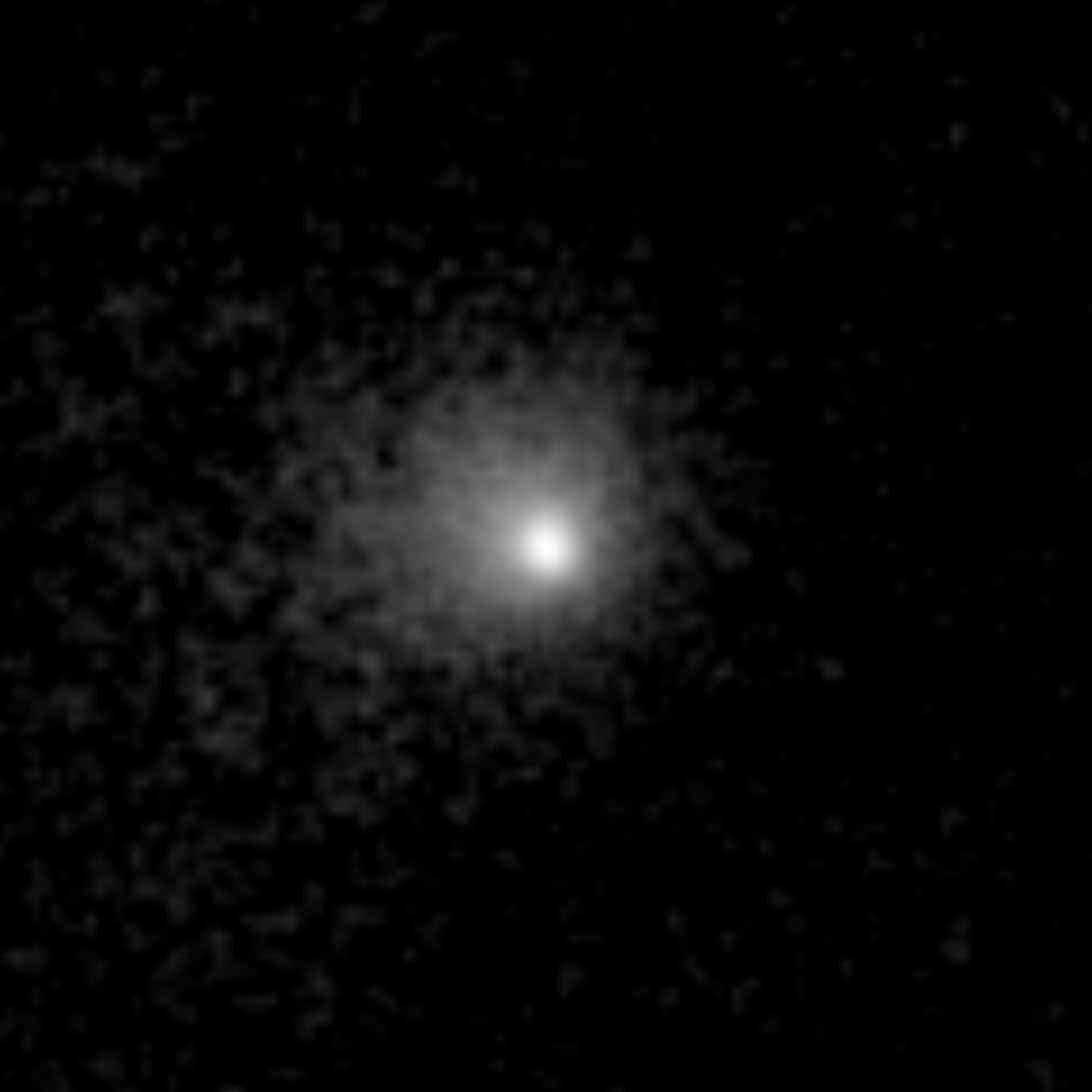
ESA announced on October 19 that Euclid has discovered its first previously unknown comet. Designated C/2026 S1 (Euclid), the object appeared in observations made during September. The Minor Planet Center confirmed it on October 8 after follow-up work, according to ESA’s discovery account.
Moving-object software developed by University of Helsinki researcher Mikko Pöntinen helped identify the candidate. A surrounding cloud of material, or coma, indicated activity characteristic of a comet. At the time described by ESA, the object was about 1.3 billion kilometres from Earth, on a path far outside the planets’ common orbital plane.
How to read the image
The released close-up composite is assembled from eight exposures, each lasting 89.5 seconds. They were aligned on the moving comet, with interfering regions masked and background objects removed. The image therefore emphasizes the coma rather than showing the untouched appearance of a single telescope exposure.
This processing helps explain why a moving object can look compact in one published image but streaked in another. The image is a carefully constructed measurement product, with its method documented alongside it.
A rehearsal for finding an encounter target
ESA says this particular comet is unsuitable for Comet Interceptor. The useful connection is the discovery-and-alert process: identifying a distant object promptly can give other observers time to establish its orbit and character.
Comet Interceptor, an ESA mission with JAXA participation, is planned to wait in space before departing toward a suitable target. Its main spacecraft would release two smaller probes, allowing simultaneous observations from different directions. ESA currently lists launch in late 2028 or early 2029.
For Euclid’s new comet, further observations should refine the orbit. For the future encounter mission, the broader lesson is operational: a discovery becomes much more useful when detection, confirmation and follow-up work together. No flyby of C/2026 S1 has been announced.
Reporting checked October 20, 2026 (UTC). Catch-up coverage of ESA’s October 19 announcement.
Image: Eight Euclid exposures aligned on comet C/2026 S1, with background objects removed. Credit: ESA/Euclid/Euclid Consortium/NASA, M. Pöntinen et al. 2026. Source image, licensed CC BY-SA 3.0 IGO. Reproduced without further image edits.
Leave a Reply